Best Home Solar Batteries in 2026: Top Options, Costs, Features, and Buying Guide
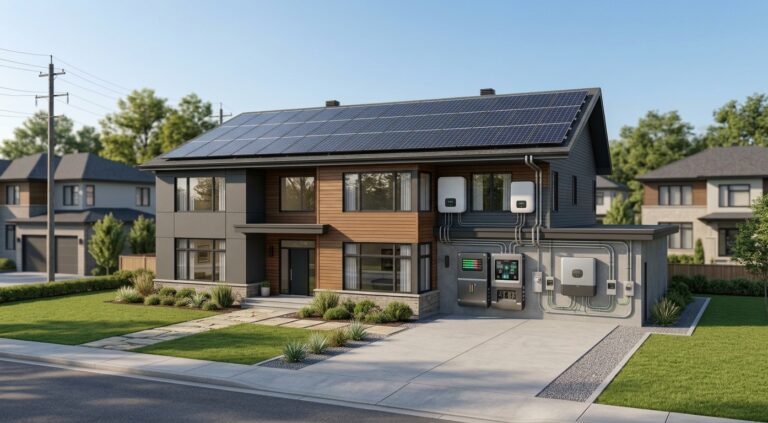
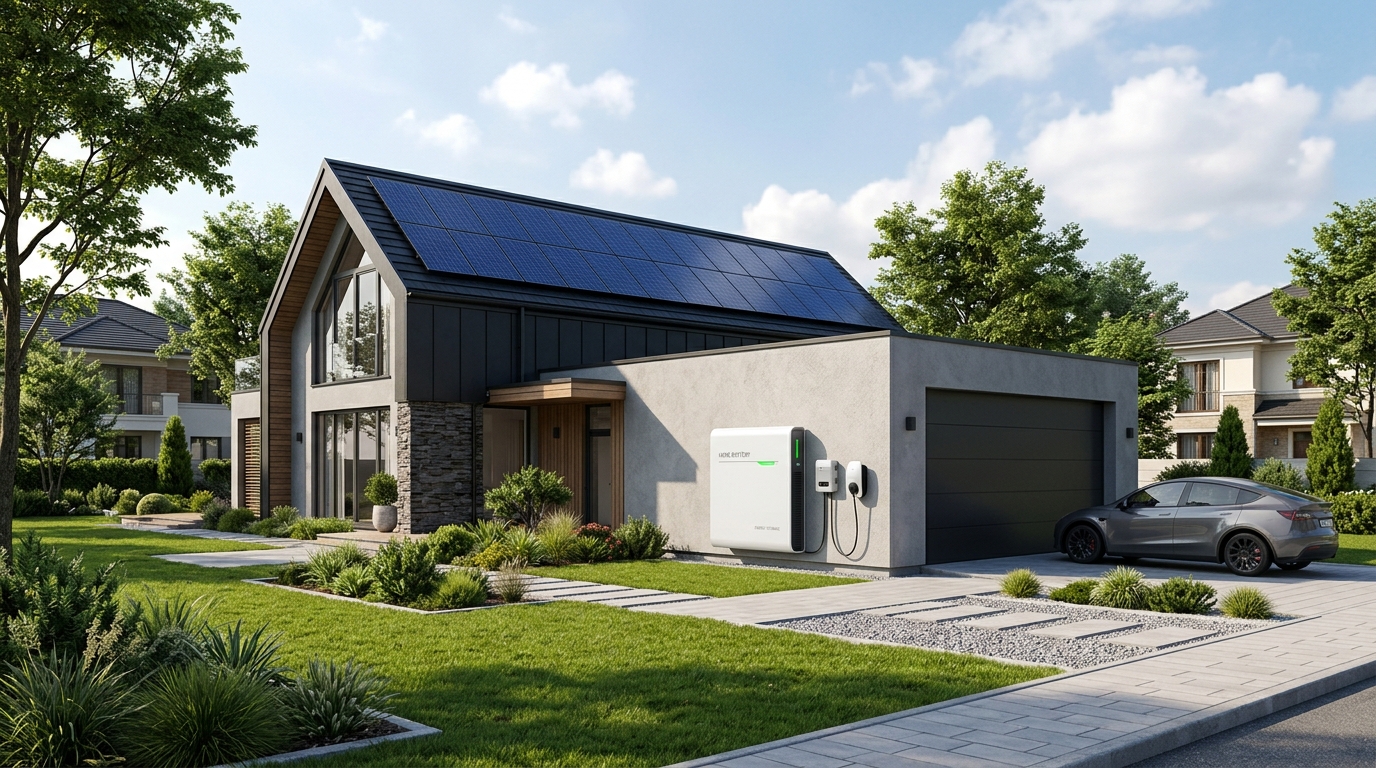
Choosing the best home solar battery in 2026 can help homeowners store renewable electricity, improve energy independence, and maintain power during electricity outages. Modern home battery systems offer different storage capacities, power outputs, battery chemistries, and smart energy management features. However, the right option depends on your household’s electricity consumption, budget, solar panel system, and backup requirements.
Some homeowners need a battery that can keep essential appliances running during an outage, while others want to store excess solar electricity and use it at night. Large households may require higher power output and expandable storage, whereas smaller homes may benefit from a compact battery system.
In this comprehensive guide, we compare popular home solar battery options, explain the features that matter most, discuss installation costs and battery lifespan, and provide practical advice to help you choose the right energy storage system.
Quick Comparison: Best Home Solar Batteries in 2026
The following products represent several approaches to residential energy storage. The best choice depends on system compatibility, installation requirements, available capacity, and your energy goals rather than brand name alone.
| Solar Battery | Main Strength | Best For |
|---|---|---|
| Tesla Powerwall 3 | Integrated battery and inverter design | Homeowners seeking an all-in-one solution |
| FranklinWH aPower 2 | High power output and backup capabilities | Homes with demanding backup requirements |
| MidNite Solar Powerflo 16 | High storage capacity in a single battery | Households requiring substantial energy storage |
| Sigenergy SigenStor BAT | Integrated smart energy management options | Homeowners planning a smart energy system |
| Enphase IQ Battery 10C | Integration with compatible Enphase equipment | Homes using Enphase solar technology |
| SolarEdge Home Battery | Integration with compatible SolarEdge equipment | Existing SolarEdge solar installations |
Product configurations, specifications, availability, and warranty terms vary by market and installation. Confirm the exact model specifications before purchasing.
What Is a Home Solar Battery?
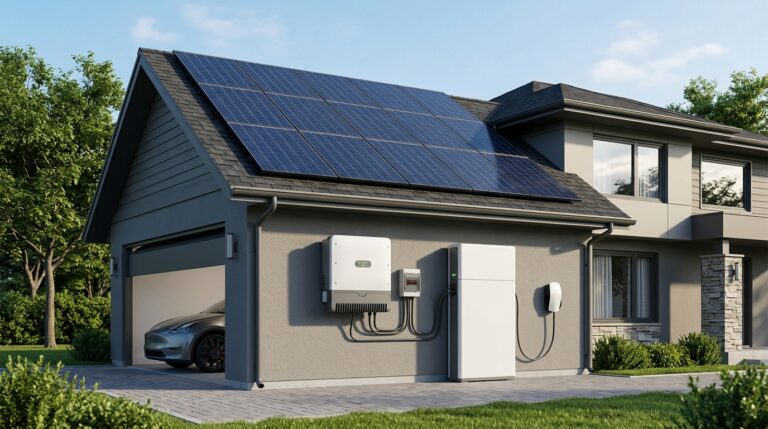
A home solar battery is an energy storage system that saves electricity for use at a later time. It is commonly installed alongside solar panels, an inverter, and electrical control equipment.
During sunny periods, solar panels generate electricity. Your home uses the energy it needs, and surplus electricity may charge the battery. When solar production decreases, stored electricity can supply compatible household appliances.
Depending on the system design, a battery may also charge from the electrical grid when electricity is available or when charging costs are lower.
How Does a Solar Battery Work?
A residential solar battery system generally follows these steps:
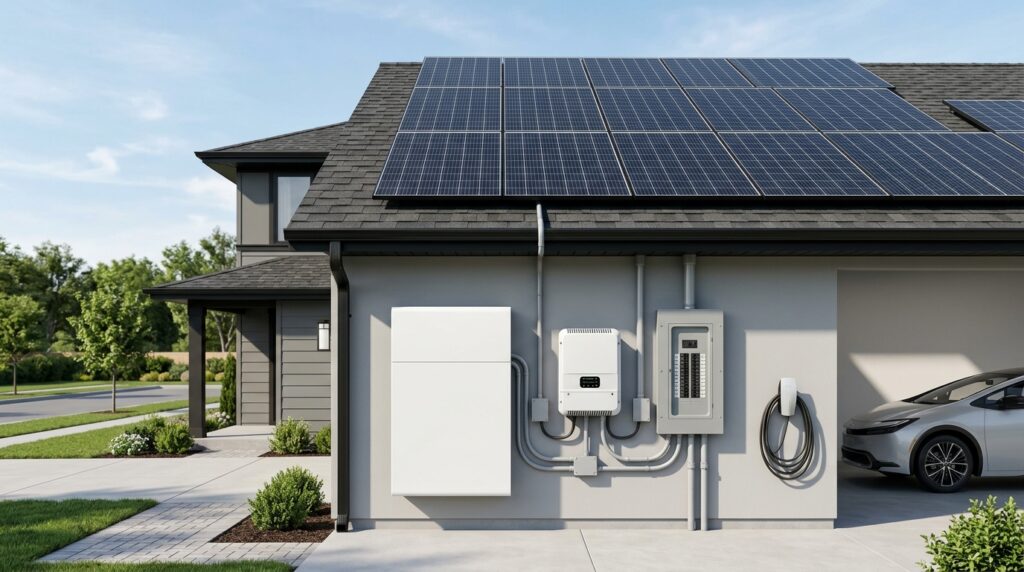
- Solar generation: Solar panels convert sunlight into electrical energy.
- Household consumption: Your home uses the electricity required by its operating appliances.
- Battery charging: Excess solar electricity charges the battery when the system permits it.
- Energy storage: The battery stores energy for later use.
- Battery discharge: Stored electricity supplies compatible loads when needed.
- Energy management: The inverter and control system manage power flows between the panels, battery, home, and grid.
The exact process depends on whether the system is AC-coupled or DC-coupled, the inverter configuration, and the battery’s capabilities.
Why Are Home Solar Batteries Becoming Popular?
Homeowners consider battery storage for several reasons.
- Backup power: Keep selected appliances operating during qualifying power outages.
- Better solar utilization: Store surplus daytime electricity for evening use.
- Electricity cost management: Reduce purchases during expensive tariff periods where time-based pricing applies.
- Energy independence: Reduce dependence on the utility grid when sufficient stored energy is available.
- Renewable energy storage: Make greater use of electricity generated by household solar panels.
- Flexible energy management: Coordinate solar production, battery charging, and household consumption.
A battery does not automatically eliminate electricity bills or guarantee uninterrupted whole-home power. Its benefits depend on battery size, household demand, solar generation, local tariffs, and system configuration.
Best Home Solar Batteries in 2026
1. Tesla Powerwall 3 — Best All-in-One Home Solar Battery
Tesla Powerwall 3 is a residential energy storage system with an integrated solar inverter. Its design combines energy storage and solar conversion capabilities in a single system, which can simplify certain new solar installations.
It is worth considering for homeowners who want to coordinate solar generation, stored electricity, and backup power through one integrated energy solution.
Key Features
- Integrated inverter design.
- Residential battery storage with approximately 13.5 kWh of usable capacity.
- Continuous power output rated at approximately 11.5 kW under specified operating conditions.
- App-based energy monitoring and management.
- Backup capabilities with the required installation and supporting equipment.
Advantages
- Combines storage and inverter functionality.
- Offers substantial energy capacity for residential applications.
- Can support a range of household backup requirements when correctly configured.
- Provides energy monitoring features.
Disadvantages
- The total installed price can be substantial.
- Compatibility and installation requirements must be evaluated for existing systems.
- Availability and installer support vary by location.
Best for: Homeowners seeking an integrated battery and inverter solution for a new or suitably designed solar installation.
2. FranklinWH aPower 2 — Best for High-Power Backup
FranklinWH aPower 2 is designed for residential energy storage and backup applications. It is worth evaluating for households that need substantial stored energy and strong power delivery during outages.
Battery capacity and power output are especially important for homes with several appliances operating simultaneously.
Key Features
- Approximately 15 kWh of usable energy storage.
- High continuous and peak power capabilities, subject to system specifications.
- Integration with compatible residential energy management equipment.
- Support for configured home backup applications.
- Expandability within supported system configurations.
Advantages
- Substantial storage capacity for household use.
- High power output can help support demanding loads when correctly designed.
- Suitable for homeowners considering broader backup coverage.
- Designed for integration with residential energy management systems.
Disadvantages
- The complete system may require additional electrical and backup equipment.
- Installation cost and compatibility depend on the home.
- Availability and after-sales service differ between markets.
Best for: Homeowners who prioritize backup capability and want to evaluate a higher-power residential storage system.
3. MidNite Solar Powerflo 16 — Best for High Storage Capacity
MidNite Solar Powerflo 16 is a residential energy storage option with approximately 16 kWh of nominal storage capacity. Its larger capacity can be useful for homes that need to store more energy for overnight use or extended backup periods.
However, storage capacity alone does not determine how many appliances a battery can operate simultaneously. Power output and inverter configuration remain essential.
Key Features
- Approximately 16 kWh of nominal energy storage.
- Residential battery storage design.
- Compatibility requirements based on the supported system configuration.
- Potential for substantial energy storage in a single battery unit.
Advantages
- High storage capacity.
- May reduce the need for multiple smaller battery units in suitable installations.
- Worth considering for households with higher daily electricity consumption.
Disadvantages
- High capacity does not automatically mean high continuous power output.
- The complete installation must support the required loads.
- Equipment availability and local service support should be checked.
Best for: Homes that need substantial stored energy and have a compatible system design.
4. Sigenergy SigenStor BAT — Best for Smart Energy Management
Sigenergy’s SigenStor product family is designed around an integrated residential energy system. Depending on the configuration, compatible components can coordinate solar generation, battery storage, and energy management.
This type of system may appeal to homeowners who want more control over when electricity is stored, consumed, and supplied to household loads.
Key Features
- Modular energy storage options depending on the selected configuration.
- Integration with compatible system components.
- Smart energy management capabilities.
- Support for different residential energy requirements.
- Monitoring and control features within the supported system ecosystem.
Advantages
- Suitable for homeowners interested in coordinated energy management.
- Different configurations can accommodate different storage requirements.
- May offer a flexible approach to combining solar generation and storage.
Disadvantages
- Available features depend on the selected components and local product range.
- Compatibility and installation requirements must be checked carefully.
- Total system cost depends on the chosen configuration.
Best for: Homeowners planning an integrated energy system with smart monitoring and control features.
5. Enphase IQ Battery 10C — Best for Compatible Enphase Solar Systems
Enphase IQ Battery 10C is a residential storage product designed to integrate with compatible Enphase equipment. It can be a practical option for homeowners who already use supported Enphase technology or are planning a compatible installation.
System integration is important because batteries, inverters, monitoring equipment, and backup components must work together correctly.
Key Features
- Approximately 10 kWh of usable energy storage.
- Integration with compatible Enphase equipment.
- Energy monitoring through supported software.
- Backup support when the required system components are installed.
- Modular options depending on system design and availability.
Advantages
- A logical option for compatible Enphase solar installations.
- Supports coordinated solar energy storage and management.
- May offer a convenient approach for homeowners staying within the same equipment ecosystem.
Disadvantages
- Compatibility depends on the existing system and product generation.
- Additional components may be necessary for backup operation.
- Installation and service availability vary by region.
Best for: Homeowners with compatible Enphase equipment who want to add residential energy storage.
6. SolarEdge Home Battery — Best for Compatible SolarEdge Systems
SolarEdge Home Battery systems are designed to work with compatible SolarEdge inverters and other supported residential energy equipment.
For homeowners with an existing SolarEdge installation, choosing a compatible battery may simplify system integration compared with introducing equipment from an unrelated ecosystem.
Key Features
- Integration with compatible SolarEdge inverters.
- Residential energy storage capabilities.
- Monitoring through supported energy management tools.
- Backup functionality when the complete installation supports it.
- Storage configurations dependent on the selected model.
Advantages
- Suitable for compatible SolarEdge solar installations.
- Supports coordinated energy storage and household energy management.
- Can be considered for selected new installations and system upgrades.
Disadvantages
- Exact inverter and battery compatibility must be confirmed.
- Backup operation may require additional equipment.
- The total installed cost depends on the configuration and electrical work.
Best for: Homeowners using compatible SolarEdge equipment who want an integrated storage solution.
How to Compare Home Solar Batteries Properly
When comparing products, focus on measurable specifications rather than marketing descriptions. A battery with the largest advertised capacity is not necessarily the best option for your household.
Usable Capacity vs. Nominal Capacity
Nominal capacity describes the battery’s stated energy storage capacity. Usable capacity describes how much energy is available for use under the specified operating conditions.
For example, a battery with 10 kWh of usable capacity can provide approximately 10 kWh of stored energy before accounting for conversion losses on the output side, subject to its operating limits.
Always compare usable capacity when estimating how long your appliances can run.
Continuous Power vs. Energy Capacity
Battery capacity is measured in kilowatt-hours (kWh), while power output is measured in kilowatts (kW).
These measurements answer different questions:
- Capacity: How much energy can the battery store?
- Continuous power: How much power can it supply continuously?
- Peak power: How much power can it supply temporarily under specified conditions?
- Starting power: Can it handle the initial surge required by certain motors or compressors?
A battery may have enough stored energy to power an appliance but still be unable to supply the power needed to start it.
Round-Trip Efficiency
Round-trip efficiency measures how much energy can be recovered after charging and discharging a battery.
For example, if a system receives 10 kWh of charging energy and returns 9 kWh of usable electricity under the relevant test conditions, its round-trip efficiency is 90%.
Higher efficiency generally means less energy is lost during the storage process. Compare figures measured on a consistent basis because manufacturers may use different test conditions.
Which Type of Solar Battery Is Best?
Battery chemistry affects energy density, operating characteristics, lifespan, safety requirements, and total cost.
Lithium Iron Phosphate (LFP) Batteries
Lithium iron phosphate, commonly called LFP, is widely used in modern stationary energy storage systems.
Benefits of LFP Batteries
- Good cycle-life potential under appropriate operating conditions.
- High usable capacity in many product designs.
- Relatively stable thermal characteristics compared with some other lithium-ion chemistries.
- Suitable for repeated daily charging and discharging.
- Generally low routine maintenance requirements.
Limitations of LFP Batteries
- Initial purchase prices can be high.
- Batteries still require suitable electrical protection and battery management.
- Cold or excessively hot operating conditions can affect performance.
- Actual lifespan depends on usage, temperature, and product quality.
LFP batteries are a strong option for many residential storage applications, but the quality of the complete system matters just as much as the chemistry.
Nickel Manganese Cobalt (NMC) Batteries
Nickel manganese cobalt, or NMC, is another lithium-ion battery chemistry.
Benefits of NMC Batteries
- High energy density in suitable designs.
- Potential for compact battery installations.
- Established use across several energy storage and electric mobility applications.
Limitations of NMC Batteries
- Thermal management and protection requirements must be considered carefully.
- Operating characteristics differ from LFP batteries.
- Product-specific lifespan, usable capacity, and warranty terms need to be evaluated.
The right chemistry depends on the application and exact product specifications. Never assume all batteries within a brand’s product range use the same chemistry.
Lead-Acid Batteries
Lead-acid batteries are a traditional energy storage option. They may have a lower upfront purchase price, but they often have lower usable capacity for a given nominal rating and can require more maintenance than sealed lithium systems.
For applications involving frequent daily cycling, the total cost of ownership should be compared carefully rather than focusing only on the initial purchase price.
Solar Battery Chemistry Comparison
| Feature | LFP Lithium | NMC Lithium | Lead-Acid |
|---|---|---|---|
| Upfront cost | Often higher | Varies by product | Often lower |
| Energy density | Moderate | Generally higher | Lower |
| Cycle-life potential | Often strong | Product-dependent | Generally lower under frequent cycling |
| Routine maintenance | Usually low | Usually low | Depends on battery type |
| Thermal considerations | Requires suitable protection | Requires suitable protection | Requires appropriate installation and ventilation |
| Best use case | Many stationary storage systems | Applications prioritizing compact storage | Selected budget or occasional-use applications |
Actual performance varies by model, temperature, charging practices, and installation conditions.
How Much Does a Home Solar Battery Cost in 2026?
The price of a home solar battery depends on its capacity, power output, chemistry, inverter requirements, installation complexity, and local market conditions.
A battery advertised at a low price may not include the components needed to connect it safely to your home or provide backup power during an outage.
What Affects Solar Battery Installation Costs?
Several factors influence the final cost.
Battery Size
Larger batteries generally cost more because they store more energy. However, the cost per usable kWh may vary between product sizes and brands.
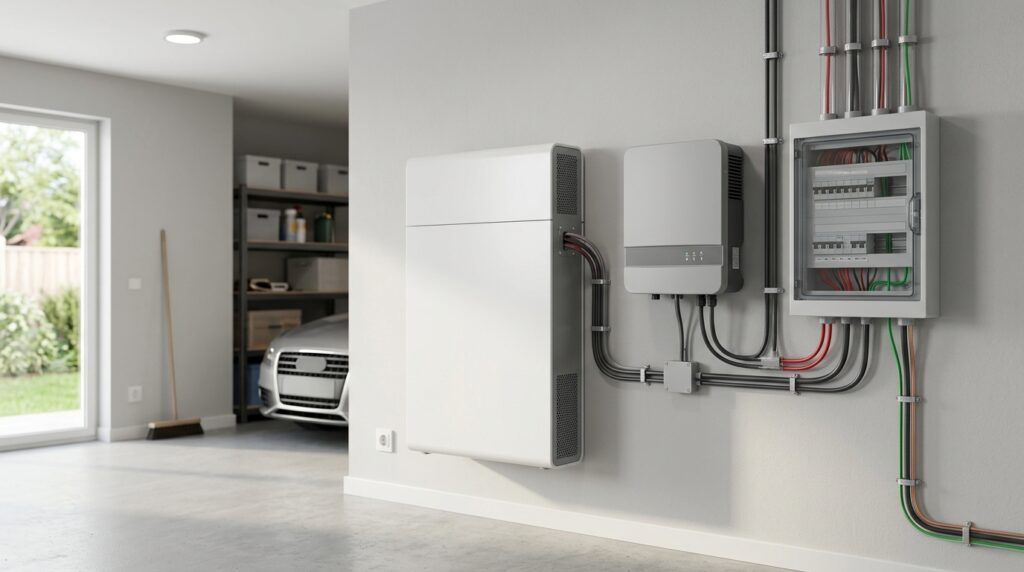
Inverter and Electrical Equipment
Some systems include an integrated inverter, while others require compatible external equipment. Additional hardware may be necessary for backup operation.
Installation and Labor
Installation costs depend on wiring, mounting requirements, electrical panel modifications, site access, and local labor rates.
Backup Configuration
Whole-home backup may require more equipment and careful load planning than backing up a few essential circuits.
Permits and Inspections
Local building codes, electrical regulations, permits, and inspections can affect the final cost.
What Should an Installation Quote Include?
| Cost component | What to confirm |
|---|---|
| Battery equipment | Exact model, usable capacity, and warranty |
| Inverter | Included or purchased separately |
| Electrical installation | Wiring, protection, and required modifications |
| Backup equipment | Circuits or equipment required during outages |
| Labor | Installation and commissioning costs |
| Permits | Applicable fees and inspection requirements |
| Service support | Warranty handling and local maintenance availability |
Ask for an itemized quote so that you can compare different installers on an equivalent basis.
How to Evaluate Long-Term Value
The cheapest battery is not necessarily the most economical over its useful life.
Consider the total installed price, expected usable energy, efficiency, warranty coverage, service costs, and the value of electricity saved or backup power provided.
If your utility pays attractive rates for exported solar electricity, a battery may deliver less financial value than it would in a location with expensive evening electricity or frequent outages.
How to Choose the Right Solar Battery for Your Home
Selecting the right battery starts with understanding your household’s energy requirements.
Step 1: Decide What You Want the Battery to Do
Identify your main objective.
- Keep essential appliances running during outages.
- Store excess solar electricity for evening use.
- Reduce electricity purchases during expensive tariff periods.
- Increase energy independence.
- Support a home that relies on solar power for much of its electricity.
Different goals require different battery capacities and power ratings.
Step 2: Calculate Your Household’s Energy Consumption
List the appliances you want to operate and estimate their electricity consumption.
For each appliance, note:
- Power rating in watts.
- Expected hours of use.
- Whether it operates continuously or intermittently.
- Any starting-power requirements.
To estimate energy consumption, multiply power in kilowatts by operating time in hours.
For example, an appliance that uses 500 watts and operates for four hours consumes approximately 2 kWh.
Add the consumption of all appliances you want to run during the backup period.
Step 3: Estimate the Required Battery Capacity
Suppose your selected appliances use approximately 2 kW on average and you want to run them for four hours.
Your estimated energy requirement is:
2 kW × 4 hours = 8 kWh.
The battery must provide enough usable energy to cover this demand, allowing for system losses and any operating reserve.
This is a simplified calculation. Real consumption changes as appliances switch on and off.
Step 4: Check the Required Power Output
Calculate which appliances may operate simultaneously.
A refrigerator, water pump, air conditioner, and electric cooking appliance can create a much higher combined load than lights and small electronics.
Confirm that the battery and inverter can support the required continuous load and any short-duration starting surges.
Step 5: Confirm System Compatibility
Before purchasing, ask a qualified installer to verify:
- Battery and inverter compatibility.
- AC-coupled or DC-coupled system requirements.
- Required control equipment.
- Backup functionality.
- Electrical protection requirements.
- Expansion options for future storage needs.
Brand names alone do not establish compatibility. Exact model numbers matter.
Step 6: Compare Warranties and Service Support
Review warranty duration, capacity-retention guarantees, cycle or energy-throughput limits, and exclusions.
Also check whether replacement equipment and qualified service technicians are available in your area.
Step 7: Compare Complete Installed Prices
Request quotations for the same usable capacity, power output, backup requirements, and installation scope.
Comparing complete systems makes it easier to identify the option that offers the best value for your needs.
Are Home Solar Batteries Worth It in 2026?
A home solar battery can be a worthwhile investment, but the financial benefits differ significantly between households.
When a Solar Battery Makes Sense
A battery may be worth considering when:
- Your home experiences frequent electricity outages.
- You generate surplus solar electricity during the day.
- Evening electricity is significantly more expensive than daytime electricity.
- Your utility provides limited compensation for exported solar electricity.
- You value backup power and greater energy independence.
When a Solar Battery May Not Be Worth the Cost
A battery may provide a lower financial return when:
- Grid electricity is reliable and relatively inexpensive.
- Your utility pays attractive rates for exported solar electricity.
- Your solar panels generate little excess energy.
- Your household consumes most electricity while the sun is shining.
- The installed battery price is high relative to the expected savings.
How to Estimate Your Payback Period
A simplified payback calculation compares the total installed cost with the estimated annual financial benefit.
For example, if a battery costs $8,000 to install and provides $1,000 in annual financial benefits, the simple payback period is approximately eight years.
This is an illustrative calculation, not a prediction of actual savings. A realistic assessment should consider battery degradation, changing electricity tariffs, maintenance, financing costs, and the value of backup power.
Common Mistakes to Avoid When Buying a Solar Battery
Choosing a Battery Without Calculating Your Needs
An undersized battery may run out of energy before the backup period ends. An oversized battery may cost more than necessary.
Calculate the energy and power requirements before selecting a product.
Ignoring Inverter Compatibility
Not every battery works with every inverter. Confirm the complete system configuration before purchasing.
Focusing Only on the Purchase Price
A lower initial price may come with lower usable capacity, a shorter warranty, additional equipment requirements, or higher long-term costs.
Assuming Solar Panels Guarantee Backup Power
Many standard grid-connected solar systems stop supplying power during a grid outage for safety reasons. Backup operation requires a suitable battery system and supporting equipment.
Ignoring Installation Conditions
Battery placement, ventilation requirements, temperature, moisture, and electrical protection affect system safety and performance.
Overlooking Warranty Details
Read the warranty conditions carefully, including throughput limits, capacity retention, and requirements for installation and operation.
Frequently Asked Questions
1. What Is the Best Home Solar Battery in 2026?
There is no universal winner for every home. Tesla Powerwall 3 is worth considering for an integrated battery and inverter solution, FranklinWH aPower 2 for high-power backup applications, and compatible Enphase or SolarEdge batteries for homeowners using those ecosystems. Compare exact specifications, installed prices, and warranties before choosing.
2. How Much Battery Capacity Does an Average Home Need?
The required capacity depends on daily electricity consumption, backup duration, and which appliances you want to power. A home backing up only lights and internet equipment will have different needs from a home running refrigerators, pumps, and air conditioning.
Calculate your expected energy use rather than relying on a generic battery-size recommendation.
3. How Long Can a Solar Battery Power a House?
Runtime depends on usable capacity and the combined load. A battery with 10 kWh of usable energy could theoretically supply a 1 kW load for about 10 hours before accounting for losses and operating limits. Higher consumption reduces runtime.
4. Can a Solar Battery Power an Entire Home?
Yes, some systems can support whole-home backup when their capacity, continuous output, inverter, and electrical configuration are suitable. Larger loads may require multiple batteries or a more powerful system.
Not every battery installation can power an entire home.
5. Are LFP Batteries Better Than Lead-Acid Batteries?
LFP batteries generally offer advantages in cycle-life potential, usable capacity, and routine maintenance for frequent cycling. Lead-acid batteries may have a lower initial purchase price. Compare usable energy, expected lifetime, maintenance, warranty, and total ownership cost.
6. Can I Add a Battery to My Existing Solar Panels?
Often, yes. However, the available options depend on your inverter, wiring, battery compatibility, and installation configuration. A qualified installer can determine whether additional equipment is required.
7. Do Solar Batteries Work During a Power Outage?
They can, provided the battery system is designed and configured for backup operation. Some installations require additional control equipment or a critical-load panel. A conventional grid-connected solar system may shut down during an outage if it lacks the necessary backup capabilities.
8. How Long Do Home Solar Batteries Last?
Battery lifespan depends on chemistry, product quality, operating temperature, cycling, and maintenance. Review the manufacturer’s warranty and expected service-life information for the exact model.
9. Do Home Solar Batteries Eliminate Electricity Bills?
No, not necessarily. A battery may reduce electricity purchased from the grid, but fixed charges, imported electricity, and other costs can remain. Actual savings depend on your electricity tariff, household consumption, and solar production.
10. Can a Solar Battery Be Expanded Later?
Some battery systems support expansion by adding compatible modules or units. Others have more restrictive configurations. Confirm the maximum supported capacity, compatibility rules, and installation requirements before purchasing.
11. Is a Bigger Solar Battery Always Better?
No. A larger battery stores more energy, but it may cost more than your household needs. The right size balances usable capacity, power output, backup duration, budget, and expected electricity savings.
12. What Should I Check Before Buying a Home Solar Battery?
Compare usable capacity, continuous power output, battery chemistry, efficiency, warranty, inverter compatibility, backup functionality, installation cost, and local service support.
These factors provide a more reliable basis for choosing a battery than brand reputation alone.
Conclusion
The best home solar batteries in 2026 are those that match your household’s energy needs, backup requirements, budget, and existing solar equipment. Tesla Powerwall 3, FranklinWH aPower 2, MidNite Solar Powerflo 16, Sigenergy SigenStor BAT, Enphase IQ Battery 10C, and SolarEdge Home Battery offer different approaches to residential energy storage.
Before making a purchase, calculate how much electricity you need to store, determine the power required by your appliances, and confirm that the battery works with your inverter. Compare complete installation prices, warranty coverage, and local service support rather than looking only at the initial equipment cost.
A properly selected solar battery can help you use more of your own solar electricity, prepare for power outages, and manage household energy more effectively. The smartest choice is the system that meets your requirements at a reasonable long-term cost, with realistic expectations about performance and savings.