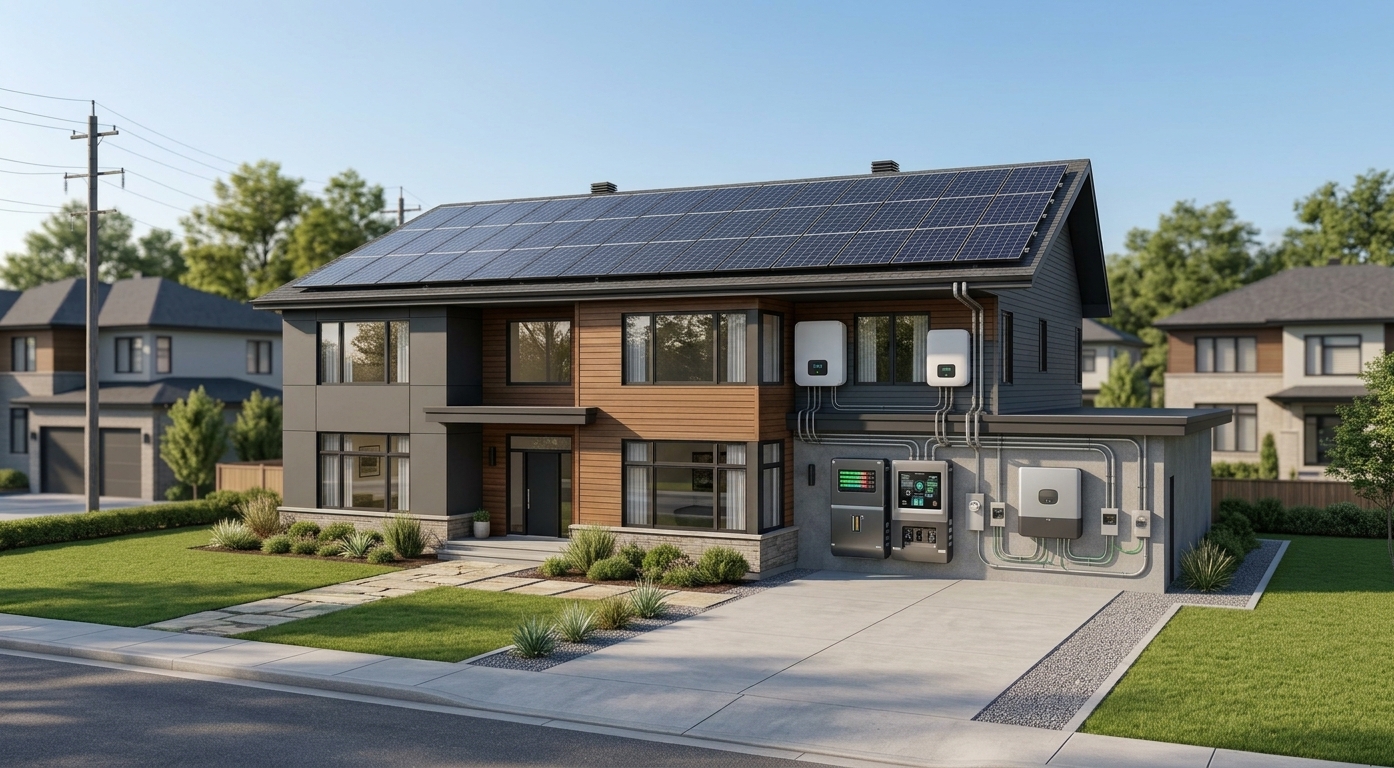
How to Choose the Right Solar Inverter for Your Home in 2026
Choosing the right solar inverter is one of the most important decisions when installing a home solar power system. Solar panels generate electricity from sunlight, but your household appliances generally use a different type of electricity. The inverter converts the power produced by your solar panels into electricity your home can use.
However, not every solar inverter works the same way. Some are designed to reduce electricity bills, others support battery storage, and some are built for homes that need backup power during grid outages. Choosing the wrong inverter can limit your solar system’s performance, increase costs, or prevent you from using essential appliances when you need them most.
So, how do you choose the right solar inverter for your home in 2026?
The best choice depends on your electricity consumption, solar panel capacity, roof layout, battery requirements, local grid conditions, and budget. This guide explains the main types of solar inverters, how to calculate the right capacity, which features matter most, and how to avoid common buying mistakes.
What Is a Solar Inverter and Why Does Your Home Need One?
A solar inverter is an electronic device that converts direct current (DC) electricity from solar panels into alternating current (AC) electricity used by most household appliances.
Solar panels produce DC electricity when sunlight reaches their cells. Most household appliances, including refrigerators, televisions, washing machines, and air conditioners, are designed to operate using AC electricity. The inverter makes the electricity generated by your solar panels suitable for your home’s electrical system.
Depending on its design, a solar inverter may also manage battery charging, monitor solar production, coordinate electricity from the grid, and provide backup power during outages.
Main Functions of a Solar Inverter
A residential solar inverter can perform several important functions:
- DC-to-AC conversion: Converts electricity from solar panels into usable household electricity.
- Power management: Helps coordinate solar generation and household consumption.
- Maximum power point tracking: Adjusts electrical operating conditions to capture available power from solar panels.
- Grid synchronization: Allows compatible grid-connected systems to operate alongside the utility supply.
- Battery management: Hybrid and battery-compatible systems can control charging and discharging.
- System monitoring: Displays information about energy production, consumption, faults, and battery status.
- Protection: Provides protective functions against certain electrical faults, depending on the model and installation.
Not every inverter includes every function. You should compare the specifications of the actual model rather than assuming that all solar inverters provide battery backup or the same safety features.
Types of Solar Inverters for Home Use
Before comparing models or prices, decide which type of inverter fits your home and energy goals.
1. String Solar Inverters
A string inverter connects a group of solar panels, called a string, to a central inverter. The inverter converts the electricity generated by those panels into AC power.
String inverters are common in residential solar installations because their design is relatively straightforward and they can offer good value.
Advantages:
- Usually lower initial cost than systems with individual microinverters.
- Centralized equipment can make some repairs and maintenance simpler.
- Suitable for many roofs with consistent sunlight.
- Available in a wide range of capacities.
Disadvantages:
- Shading on one or more panels can reduce the performance of the affected string.
- Different roof directions may require careful string design and additional MPPT inputs.
- A central inverter failure can interrupt conversion for the connected solar array.
Best for: Homes with relatively unshaded roofs, straightforward panel layouts, and a priority on keeping installation costs manageable.
2. Hybrid Solar Inverters
A hybrid inverter combines solar conversion with battery-management capabilities. It can coordinate electricity from solar panels, compatible batteries, the grid, and household loads.
Some hybrid systems allow homeowners to install a battery immediately, while others support adding compatible storage later.
Advantages:
- Supports battery integration when the correct battery is selected.
- Can store surplus solar energy for use later.
- May provide backup power during outages when properly configured.
- Can offer flexible energy-management features.
Disadvantages:
- Often costs more than a basic grid-tied inverter.
- Battery compatibility must be checked carefully.
- Backup operation may require additional equipment and electrical work.
- Some advanced features may be unnecessary for homes that do not need storage.
Best for: Homeowners who want solar savings and the option to use battery backup, especially where grid outages are a concern.
Remember that buying a hybrid inverter does not automatically mean your home will remain powered during an outage. The inverter must support backup operation, and the installation must include the necessary battery, switching arrangements, and suitable circuits.
3. Off-Grid Solar Inverters
An off-grid inverter is designed for a solar power system that operates independently of the utility grid. Such systems typically rely on battery storage to provide electricity when solar panels are not generating enough power.
Some models can also accept electricity from a generator or another compatible source.
Advantages:
- Suitable for homes in remote locations without reliable grid access.
- Can operate as part of a standalone solar-and-battery system.
- Offers greater independence from utility electricity when correctly sized.
Disadvantages:
- Requires careful planning of battery capacity and energy consumption.
- May need a backup generator for prolonged periods of poor solar production.
- Can be expensive when designed to power a large home reliably.
- Incorrect sizing can lead to frequent low-battery conditions.
Best for: Remote houses, cabins, farms, and properties where a grid connection is unavailable or unreliable.
4. Microinverters
Microinverters are installed at individual solar panels or small groups of panels, depending on the system design. Each microinverter converts DC electricity into AC electricity close to the panel.
Because panels can operate more independently, microinverters may help reduce the impact of certain shading conditions or differences in roof orientation.
Advantages:
- Panel-level monitoring is often available.
- Can be useful for roofs with multiple orientations.
- Shading on one panel may have less effect on other panels than in some string configurations.
- Expanding a system may be straightforward with compatible equipment and electrical capacity.
Disadvantages:
- Initial equipment cost can be higher.
- More electronic devices are installed on or near the roof.
- Servicing rooftop equipment may require roof access.
- Battery backup requires a compatible system design and is not guaranteed by the presence of microinverters.
Best for: Homes with complicated roof layouts, multiple panel orientations, or shading that makes a traditional string design less attractive.
5. String Inverters With Power Optimizers
Power optimizers are electronic devices installed at individual panels. They adjust the operating conditions of each panel and work with a compatible central inverter.
This setup can improve energy harvesting when panels experience different conditions, while providing panel-level monitoring on supported systems.
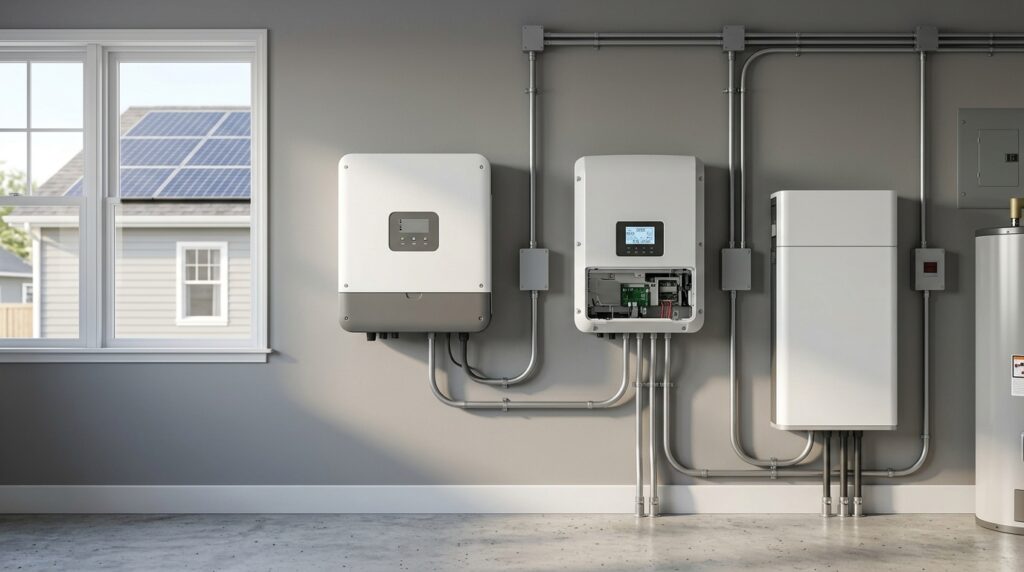
However, optimizers do not eliminate every shading loss, and their benefits depend on the roof layout and equipment design.
Best for: Homes that need panel-level optimization but prefer a system built around a central inverter.
Solar Inverter Types Compared
| Inverter Type | Initial Cost | Battery Support | Suitable Roof Layout | Main Advantage |
|---|---|---|---|---|
| String inverter | Usually lower | Depends on model and system | Simple, relatively unshaded roofs | Cost-effective design |
| Hybrid inverter | Medium to high | Designed for compatible storage | Many residential layouts | Solar and battery management |
| Off-grid inverter | Varies; full system can be expensive | Usually essential to the system | Remote or standalone installations | Independent operation |
| Microinverters | Often higher | Requires compatible system design | Multiple orientations or partial shading | Panel-level conversion |
| String inverter with optimizers | Usually higher than basic string setup | Depends on inverter configuration | Roofs with differing panel conditions | Panel-level optimization |
Actual prices and capabilities vary by manufacturer, model, region, and installation requirements.
How to Choose the Correct Solar Inverter Capacity
Inverter capacity is one of the most important specifications to evaluate. A unit that is too small may limit how much power your home can use at once, while an unnecessarily large unit may increase your upfront cost.
The correct capacity depends on two related but different requirements: how much power your solar panels can produce and how much power your home may need at one time.
1. Calculate Your Household’s Electricity Requirements
Start by identifying the appliances you want to run on solar power.
Make a list of the appliances that might operate simultaneously and estimate their power consumption. Check appliance labels or manufacturer specifications instead of relying only on general averages.
For example, a household may use:
| Appliance | Illustrative Running Power |
|---|---|
| LED lights | 100 W total |
| Television | 120 W |
| Refrigerator | 200 W while running |
| Fans | 240 W total |
| Laptop and small electronics | 100 W |
| One air conditioner | 1,200 W |
| Water pump | 750 W |
These values are examples only. Actual consumption depends on the appliance model, operating conditions, and motor efficiency.
If all these appliances were operating at their illustrative running loads simultaneously, their combined demand would be approximately 2,710 watts, or 2.71 kW. However, the inverter must also account for startup surges from motors and compressors.
2. Consider Starting Power and Surge Capacity
Some appliances briefly require more power when starting than they use during normal operation. This can apply to refrigerators, pumps, air conditioners, and other motor-driven equipment.
If the inverter cannot handle the startup demand, it may shut down or trigger an overload warning even when the normal running load appears acceptable.
When comparing inverters, check:
- Continuous AC output power.
- Peak or surge power rating.
- How long the inverter can provide its stated surge power.
- Compatibility with the appliances you want to operate.
- Whether several high-demand appliances may start simultaneously.
Do not assume that a large advertised surge figure means the inverter can sustain that power for a long period.
3. Match the Inverter to Your Solar Panel Capacity
Solar panel capacity is usually expressed in kilowatts of direct-current power (kW DC), while inverter output is commonly expressed in kilowatts of alternating-current power (kW AC).
These figures do not always need to be identical. Solar arrays are often designed with a DC capacity somewhat higher than the inverter’s AC rating because panels rarely operate continuously at their rated peak output.
For example, a 6 kW solar array might be paired with an inverter rated around 5 kW AC, if the inverter manufacturer permits that array size and the design meets all voltage and current limits.
The right pairing depends on:
- Maximum permitted solar array capacity.
- Maximum DC input voltage.
- MPPT operating voltage range.
- Maximum input current per MPPT.
- Short-circuit current limits.
- Expected local temperature and solar conditions.
- Applicable electrical and utility requirements.
Never select an inverter based only on the headline kW figure. Its detailed electrical input specifications must match the panel configuration.
4. Check Whether You Need Single-Phase or Three-Phase Power
Residential properties may have single-phase or three-phase electrical supplies. The appropriate inverter depends on the home’s electrical service, system capacity, local regulations, and the way loads are distributed.
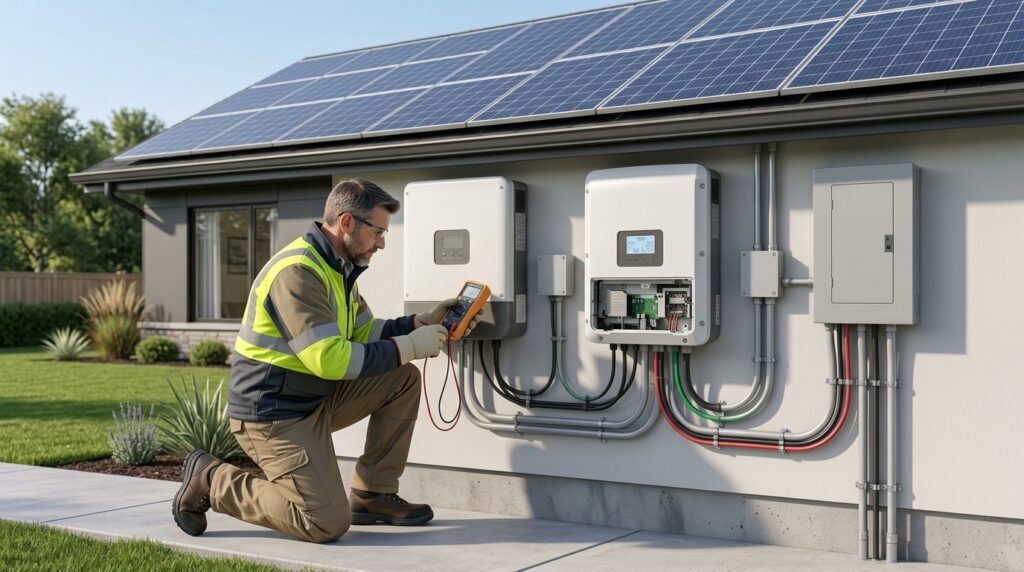
A three-phase inverter may be suitable for a property with a three-phase supply, especially when the system is larger or has significant three-phase loads.
Before purchasing, have a qualified installer confirm the electrical supply type and any local restrictions on grid connection or electricity export.
How to Choose Between On-Grid, Hybrid, and Off-Grid Inverters
The right inverter depends on what you expect your solar system to accomplish.
Choose an On-Grid Inverter if Your Main Goal Is Lower Electricity Bills
An on-grid inverter works with the utility grid and allows solar electricity to supply household loads. Depending on system design and local utility rules, excess electricity may be exported.
This option may be suitable if:
- Your grid supply is generally reliable.
- Your priority is reducing electricity purchases.
- You do not require battery backup.
- You want to minimize initial equipment costs.
Important: Standard grid-tied inverters generally shut down during a grid outage to protect utility workers and equipment. Solar panels alone do not guarantee electricity during a blackout.
Choose a Hybrid Inverter if You Want Battery Backup
A hybrid inverter is worth considering when you want to use solar energy during the day, store surplus energy, and potentially power selected circuits during a grid outage.
Check whether the model supports the battery chemistry and voltage you plan to use, as well as the backup power output you require.
A hybrid inverter may be a good choice if you expect to install batteries later, but confirm the exact supported configurations before paying extra for this capability.
Choose an Off-Grid Inverter if You Need Independent Power
An off-grid system may be appropriate if your property does not have a reliable utility connection.
The system must be designed around daily energy consumption, battery storage, seasonal solar production, and periods of poor weather. If uninterrupted electricity is essential, a compatible backup generator may also be worth considering.
Solar Inverter Features You Should Check Before Buying
The product’s specifications can reveal whether it is suitable for your home. Compare these features carefully rather than choosing solely on price or advertised power.
1. Maximum Power Point Tracking (MPPT)
MPPT helps the inverter extract available power from the solar array as sunlight and panel conditions change.
An inverter may have one or several MPPT inputs. Multiple MPPTs can be useful when panels face different directions or experience different shading conditions.
However, more MPPTs do not automatically mean a better inverter. The number and electrical limits must suit your actual panel layout.
2. Battery Compatibility
If you plan to use battery storage, check:
- Supported battery voltage range.
- Compatible battery chemistry.
- Supported battery models and communication protocols.
- Maximum charging and discharging current.
- Maximum battery charging and discharging power.
- Whether the inverter supports the battery’s battery-management system (BMS).
- Whether firmware or configuration requirements apply.
Lithium batteries often communicate with compatible inverters through supported protocols such as CAN or RS485. Compatibility must be confirmed for the specific battery and inverter combination.
Two products that use the same nominal voltage are not necessarily compatible.
3. Backup Power Capability
If you experience power outages, confirm that the inverter can supply backup electricity and understand exactly how it operates.
Questions to ask include:
- Does backup operation require a battery?
- Which circuits can receive backup power?
- What is the maximum backup output?
- Can the inverter handle the starting surge of your appliances?
- How quickly does the system switch to backup power?
- Does backup work during the day when the battery is low?
- Can the inverter restart when the battery is deeply discharged?
- Is additional transfer or isolation equipment required?
Some inverters provide a dedicated backup output, while others require extra components. A system designed for selected essential circuits may be less expensive than one intended to power an entire house.
4. Conversion Efficiency
Inverter efficiency describes how effectively the device converts input electricity into usable output electricity under specified conditions.
Higher efficiency can reduce conversion losses, but published peak efficiency does not tell the whole story. Real-world performance also depends on the inverter’s operating load, temperature, standby consumption, and system configuration.
Compare the manufacturer’s efficiency specifications and consider how the inverter will operate during typical daily conditions.
5. Monitoring and Smart Features
Many modern inverters include monitoring through a display, mobile application, or web-based dashboard.
Useful monitoring features can include:
- Current solar generation.
- Household electricity consumption.
- Grid imports and exports.
- Battery state of charge.
- Historical energy production.
- Fault and maintenance alerts.
Some features require internet connectivity, a separate meter, additional sensors, or paid services. Check what is included before buying.
6. Protection and Safety Features
Look for appropriate electrical protection, which may include overcurrent protection, overvoltage protection, temperature protection, ground-fault monitoring, and anti-islanding functionality for grid-connected systems.
The exact protection features differ by inverter type and model. Your installer must also provide correctly selected breakers, disconnects, wiring, grounding, and any required surge protection.
The inverter itself cannot compensate for unsafe wiring or a poorly designed installation.
7. Enclosure Rating and Installation Environment
The installation environment can affect reliability and service life.
Check the enclosure’s ingress protection (IP) rating, allowable operating temperature, ventilation requirements, and any restrictions on indoor or outdoor installation.
Avoid installing an inverter in a location that exceeds its environmental limits. Direct sunlight, excessive heat, moisture, dust, and inadequate ventilation can affect performance or durability.
8. Warranty and Local Service
A solar inverter may need repair or replacement before the solar panels reach the end of their useful life. Warranty support and availability of replacement equipment therefore matter.
Before buying, check:
- Length and conditions of the product warranty.
- Whether registration is required.
- Which components and labor are covered.
- Availability of authorized service.
- Access to replacement parts.
- Warranty exclusions related to installation or incompatible batteries.
A slightly more expensive inverter with dependable local support may offer better long-term value than a cheaper model with uncertain repair options.
How Much Does a Solar Inverter Cost?
Solar inverter prices vary by country, brand, power rating, features, and installation complexity. Hybrid models generally cost more than basic grid-tied models with similar output capacity because they include additional battery-management capabilities.
Microinverter and optimizer-based systems may also have higher equipment costs because they use additional electronic components.
Rather than relying on one universal price, compare written quotations for the exact models and installation requirements.
Factors That Affect Solar Inverter Cost
| Factor | Potential Effect on Cost |
|---|---|
| Inverter capacity | Higher power ratings generally cost more |
| Inverter type | Hybrid and specialized systems may cost more |
| Number of MPPT inputs | Additional tracking capability may affect price |
| Battery compatibility | May require more advanced equipment |
| Backup functionality | Can require extra hardware and installation |
| Monitoring features | Advanced meters or communication devices may add cost |
| Warranty and service | Better coverage and support may affect the purchase price |
| Installation complexity | Electrical upgrades and additional wiring increase total cost |
Should You Buy the Cheapest Solar Inverter?
The cheapest inverter is not always the best value. A low initial price may come with limited monitoring, insufficient backup capability, poor compatibility, a short warranty, or difficult access to repairs.
On the other hand, paying extra for features you will never use may not make financial sense either.
The goal is to find a model that meets your technical requirements, has reliable support, and fits your budget.
Best Solar Inverter Features for Different Types of Homes
Different homes have different priorities. Use the following recommendations as a starting point.
For a Small Home
A small home with modest electricity consumption may need a lower-capacity inverter and a straightforward system design.
Prioritize appropriate output capacity, reliable protection, good monitoring, and a warranty that suits your needs.
For a Large Home
A large home with several air conditioners, electric heating, pumps, or other high-power appliances may require a higher-capacity system or a carefully designed multi-inverter configuration.
Pay particular attention to continuous output, motor-starting loads, electrical service type, and simultaneous appliance use.
For a Home With Frequent Power Outages
A hybrid inverter with compatible battery storage may be appropriate.
Calculate the energy required for essential appliances and verify both the inverter’s backup power output and the battery’s usable capacity. A large battery cannot compensate for an inverter that cannot deliver enough power to start or run your appliances.
For a Home With a Shaded or Complicated Roof
Microinverters, power optimizers, or a well-designed multi-MPPT string inverter may help manage different roof orientations and shading.
The best solution depends on the actual shade pattern, panel layout, installation cost, and maintenance considerations.
For a Home That May Add Batteries Later
A hybrid inverter may provide flexibility, but only if it supports your intended battery configuration.
Before buying, check whether the battery can be added without replacing the inverter and whether any additional equipment will be needed.
Common Solar Inverter Buying Mistakes to Avoid
1. Choosing an Inverter Without Calculating the Load
A unit that cannot handle simultaneous appliance demand or motor-starting surges may repeatedly overload.
Prepare a realistic load list before choosing the capacity.
2. Assuming Every Hybrid Inverter Supports Every Battery
Battery voltage, chemistry, communication, charging limits, and firmware compatibility all matter.
Always verify the exact pairing rather than relying on a general claim that a model is battery-ready.
3. Assuming Solar Panels Will Work During Every Outage
Many grid-tied systems stop supplying power when the grid fails. Backup operation requires suitable equipment and an approved electrical configuration.
4. Ignoring Solar Panel Input Limits
An inverter may have an AC output rating that appears suitable but still be incompatible with a proposed panel array’s voltage or current.
Have the panel strings checked against the inverter’s technical specifications.
5. Ignoring Warranty and Repair Availability
A solar system is a long-term investment. Check how warranty claims, troubleshooting, replacement parts, and service will be handled.
6. Buying More Capacity Than You Need
A larger inverter may increase the upfront cost without delivering meaningful benefits if your home does not require the additional power.
Size the system for realistic demand and reasonable future expansion.
7. Neglecting Installation Quality
Poor wiring, unsuitable mounting, inadequate ventilation, and incorrect protection can compromise performance and safety.
Use a qualified installer who understands the relevant electrical requirements and local regulations.
Solar Inverter Maintenance Tips
A properly installed inverter generally requires less routine attention than many mechanical appliances, but periodic checks are still important.
Keep the Installation Area Clear
Maintain the clearances specified by the manufacturer. Do not block cooling vents or store items where they could interfere with ventilation.
Monitor Performance
Review energy production and fault notifications periodically. A sudden unexplained drop in production may indicate shading, a wiring issue, a fault, or a change in weather conditions.
Check for Warning Signs
Contact a qualified technician if you notice repeated shutdowns, unusual smells, visible damage, overheating warnings, or persistent fault messages.
Do not open the inverter enclosure or attempt electrical repairs unless you are qualified and the equipment has been made safe according to the manufacturer’s instructions.
Follow the Manufacturer’s Maintenance Schedule
Some systems need periodic inspection of connections, cooling components, and protective equipment. Follow the recommended service intervals and keep records of repairs.
Keep Firmware and Monitoring Configurations Appropriate
Where the manufacturer supports firmware updates, follow the approved update process. Ensure that configuration changes are made by someone qualified to understand their electrical and operational consequences.
Frequently Asked Questions About Choosing a Solar Inverter
1. Which solar inverter is best for a home in 2026?
The best inverter depends on your electricity needs. A string inverter may be suitable for a simple, unshaded roof, while a hybrid inverter is worth considering if you need battery storage and backup power. Microinverters or optimizers may suit roofs with shading or multiple orientations.
2. How do I calculate the inverter size for my home?
List the appliances you expect to run simultaneously, estimate their running power, and account for startup surges. Then check the inverter’s continuous output, surge capability, and compatibility with your solar array. A qualified installer can verify the final design.
3. Is a hybrid inverter better than an on-grid inverter?
A hybrid inverter offers battery-management capabilities that a basic grid-tied inverter may not provide. However, it usually costs more. If you only want to reduce electricity bills and do not need battery storage, a basic grid-tied system may be more economical.
4. Can I use a solar inverter without batteries?
Yes. Many grid-tied solar systems operate without batteries. Some hybrid inverters can also operate without a battery in certain configurations, but their capabilities depend on the model and system design.
5. Will a solar inverter work during a power outage?
A standard grid-tied inverter generally shuts down during a grid outage. A system designed for backup operation may continue supplying selected loads, provided the required equipment and energy sources are available.
6. How many solar panels can I connect to one inverter?
It depends on the inverter’s maximum permitted solar array capacity, DC voltage range, current limits, MPPT inputs, and the electrical specifications of the panels. The number of panels alone is not enough to determine compatibility.
7. What is MPPT in a solar inverter?
Maximum power point tracking, or MPPT, adjusts the electrical operating point of a solar array to help extract available power as sunlight and panel conditions change. The number of MPPT inputs can be important when panels face different directions or experience different shading.
8. Are microinverters better than string inverters?
Neither is always better. String inverters can be cost-effective for simple, unshaded roofs. Microinverters may be useful where panels have different orientations or shading conditions. Compare the expected production, equipment cost, warranty, and maintenance requirements for your roof.
9. How long does a solar inverter last?
The lifespan depends on the inverter model, operating conditions, installation quality, and maintenance. Inverters may need replacement before the solar panels reach the end of their useful life. Review the product warranty and plan for possible future replacement.
10. Can I add a battery to my existing solar inverter?
Sometimes. A compatible hybrid inverter may support a battery addition, while an existing grid-tied system may be able to use an AC-coupled battery system with separate equipment. Compatibility and installation requirements must be checked before making a decision.
11. Does a higher-efficiency inverter always save more money?
Not necessarily. Efficiency is important, but the difference in real-world energy losses may be small compared with factors such as system design, shading, equipment reliability, and installation cost. Compare the complete system rather than relying on peak efficiency alone.
12. What should I check before purchasing a solar inverter?
Check the inverter type, continuous output, surge capability, solar input limits, MPPT configuration, battery compatibility, backup features, efficiency, safety protections, warranty, and local repair support. Confirm that the selected model suits your electrical supply and local requirements.
Final Verdict: How to Choose the Right Solar Inverter for Your Home
Choosing the right solar inverter starts with understanding how you use electricity and what you expect from your solar system.
A string inverter is often a practical choice for a straightforward roof and a budget-conscious installation. A hybrid inverter is worth considering if you want battery storage and properly configured backup power. An off-grid inverter is designed for properties that need an independent energy system, while microinverters and power optimizers may help on roofs with more complicated shading or orientations.
Before making your decision, calculate your household load, confirm solar panel input compatibility, consider battery requirements, and compare warranties and service support. Ask for a complete system design rather than choosing an inverter based on its advertised capacity alone.
The right solar inverter is one that safely matches your solar panels, meets your household’s power requirements, supports your future plans, and delivers dependable value over the life of your solar system.