Best Home Backup Generators in 2026: Top Picks, Features, Prices, and Buying Guide
Power outages can interrupt daily routines, damage sensitive equipment, spoil refrigerated food, and make working from home difficult. A reliable home backup generator can help keep essential appliances running when the electricity supply fails. Depending on its size and configuration, a generator can power a few important devices, support several household appliances, or provide backup electricity for much of an entire home.
The best home backup generators in 2026 offer a balance of power output, fuel efficiency, reliability, noise control, safety features, and ease of use. However, the right generator for a small apartment or occasional outage may be very different from the system needed for a large home with central air conditioning, electric appliances, or a private well.
This guide explores leading generator options, explains the differences between portable and standby systems, and shows you how to choose the right backup power solution for your household.
Best Home Backup Generators in 2026: Quick Comparison
The following generators and generator families are worth considering for different backup needs. Individual configurations, specifications, fuel compatibility, and regional availability may vary.
| Generator | Type | Best For | Main Advantage |
|---|---|---|---|
| Honda EU7000iS | Portable inverter | Quiet backup and sensitive electronics | Refined operation and inverter-generated power |
| Westinghouse WGen9500DF | Portable dual-fuel | Essential household appliances | High output and fuel flexibility |
| Champion 4500-Watt Dual Fuel Inverter | Portable inverter | Smaller homes and essential devices | Quieter operation and dual-fuel options |
| Generac GP8000E | Portable conventional | General household backup | Practical power for selected appliances |
| Generac Guardian 22kW | Standby generator | Automatic whole-home backup | Permanently installed automatic operation |
| Kohler 20RCAL class | Standby generator | Larger household backup | High-output standby capability |
| Champion home standby systems | Standby generator | Automatic backup at different power levels | Multiple capacity and fuel configurations |
Important: Generator output, fuel consumption, and available outlets vary by model. Confirm the exact specification sheet for the unit sold in your country before purchasing.
What Is a Home Backup Generator?
A home backup generator is a machine that supplies electricity when the normal power supply becomes unavailable. Most conventional generators use an internal combustion engine powered by gasoline, propane, natural gas, or diesel. The engine drives an electrical generator that produces usable electricity.
Unlike a portable battery power station, a fuel-powered generator can continue producing electricity as long as it has a suitable fuel supply and is operated within its rated limits.
How Does a Home Generator Work?
A typical fuel-powered generator includes several main components:
- Engine: Converts fuel energy into mechanical movement.
- Alternator: Converts mechanical movement into electricity.
- Voltage regulation system: Helps control the electrical output.
- Control panel: Provides outlets, controls, and operating information.
- Protection systems: Help protect against certain electrical or engine faults.
- Fuel system: Stores or receives fuel needed to operate the engine.
When a generator is started, the engine drives the alternator to produce electricity. Connected appliances then draw power from the generator, subject to its continuous output rating and temporary surge capacity.
A portable generator usually requires manual setup and starting. A permanently installed standby generator can work with an automatic transfer switch, allowing it to start when a power failure is detected and stop when utility electricity returns.
Types of Home Backup Generators
Understanding the different generator types is the first step toward choosing the right system.
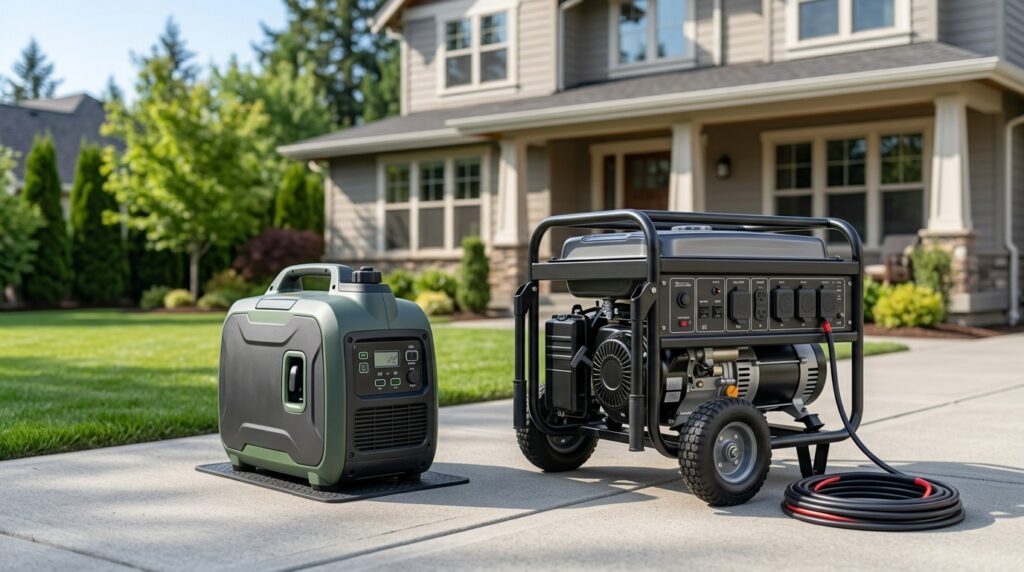
1. Portable Generators
Portable generators are movable units designed to supply electricity through built-in outlets or an approved connection to selected household circuits.
They are usually less expensive than permanently installed standby systems and can be stored when not in use. However, they need to be moved to a safe outdoor location, started, monitored, and refueled when necessary.
Portable generators are suitable for occasional outages, smaller budgets, and households that only need to power essential appliances.
2. Inverter Generators
Inverter generators use electronics to convert generated electricity into a controlled AC output. Many models adjust engine speed according to demand, which can improve fuel efficiency and reduce noise at lighter loads.
They are often a good choice for sensitive electronics, laptops, networking equipment, and households that value quieter operation.
However, inverter generators can cost more than conventional generators with similar output ratings. Their actual suitability depends on the rated power, electrical specifications, and manufacturer guidance.
3. Dual-Fuel Generators
Dual-fuel generators can operate using two compatible fuel types, commonly gasoline and propane. Some models support other fuel arrangements, but compatibility should never be assumed.
Having two fuel options can be useful when one fuel becomes difficult to obtain during a prolonged outage. Fuel consumption and power output may differ between fuel types, so check the ratings for both operating modes.
4. Whole-House Standby Generators
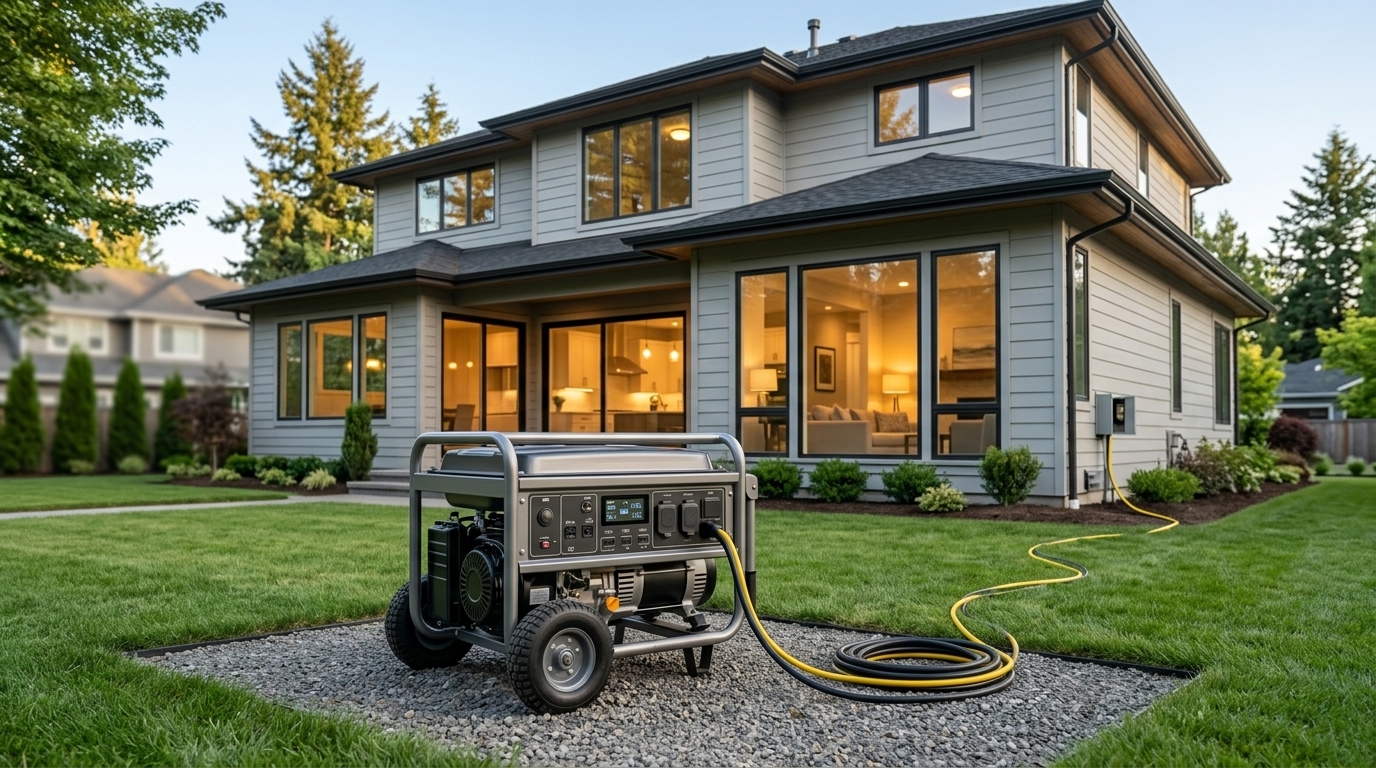
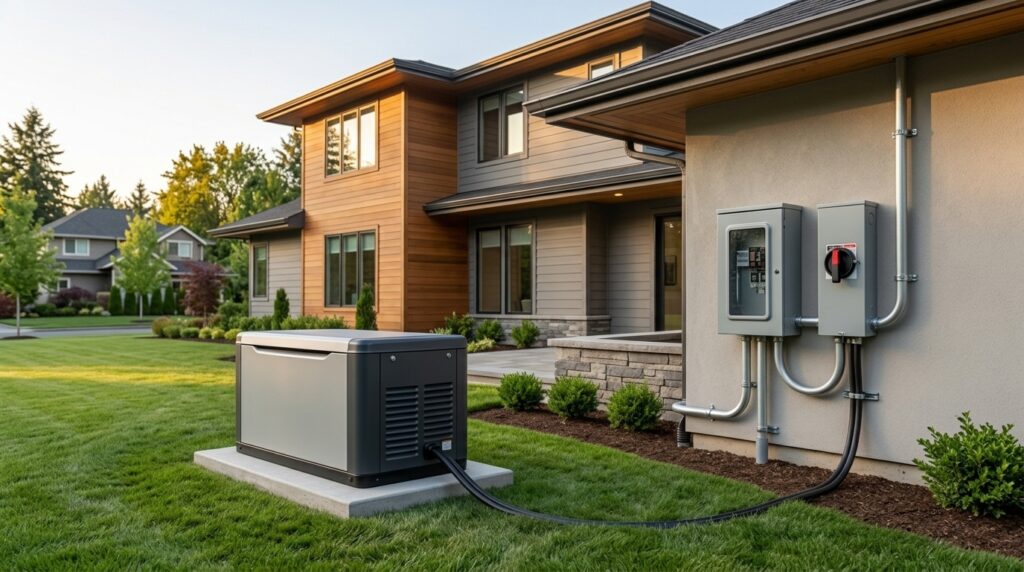
A standby generator is permanently installed outside the home and connected through an appropriate transfer system. Many models start automatically when the normal electricity supply fails.
Depending on their capacity and installation, standby generators can support selected household circuits or much of an entire home.
They usually cost significantly more than portable generators because the overall project may include the generator, transfer equipment, electrical work, fuel connections, permits, and a suitable installation base.
5. Diesel Generators
Diesel generators are used in some residential, commercial, and off-grid applications. Diesel fuel can offer advantages for certain larger systems, but the installation must account for noise, exhaust, fuel storage, maintenance, and local regulations.
A diesel generator is not automatically the best residential choice. Its suitability depends on the size of the load, fuel availability, operating schedule, and installation requirements.
1. Honda EU7000iS: Best for Quiet Portable Backup
The Honda EU7000iS is a portable inverter generator designed for users who want substantial portable power with a focus on refined operation. It can be considered for essential household equipment, electronics, and selected appliances during an outage.
Key Features
- Portable inverter generator design.
- Approximately 5,500 watts of rated output.
- Approximately 7,000 watts of maximum output.
- Gasoline-powered operation.
- Electric starting.
- Inverter technology for controlled electrical output.
- A design intended to reduce operating noise compared with many conventional generators in similar applications.
Why Consider the Honda EU7000iS?
Its inverter system makes it an option for users who need portable power for computers, networking equipment, and other compatible electronics. The rated output also gives it more capability than very small generators intended mainly for recreational use.
A portable design can be useful if you need backup power at home and want a generator that can also serve other approved applications.
Potential Limitations
The EU7000iS is not a lightweight generator. Its size, weight, and purchase price may make it unsuitable for users who need an inexpensive unit that can be carried frequently.
Its gasoline engine also requires outdoor operation, refueling, periodic maintenance, and safe fuel storage. It does not provide automatic whole-home backup without a suitable, approved setup.
Who Should Choose It?
Consider this generator if you value inverter technology, want substantial portable output, and are prepared to pay more for a generator designed around refined operation.
2. Westinghouse WGen9500DF: Best for Dual-Fuel Household Backup
The Westinghouse WGen9500DF is a portable dual-fuel generator designed to supply electricity to multiple appliances during an outage. Its fuel flexibility is particularly useful for households that want an alternative to relying entirely on gasoline.
Key Features
- Portable conventional generator design.
- Approximately 9,500 running watts on gasoline in the relevant configuration.
- Higher maximum output than its running rating.
- Dual-fuel operation using compatible gasoline and propane configurations.
- Electric starting on supported versions.
- Multiple power outlets, depending on the exact model.
- Suitable for selected household loads when correctly sized.
Why Consider the Westinghouse WGen9500DF?
A generator in this output class can support several essential appliances, provided their combined running demand and starting surges remain within the generator’s limits.
Dual-fuel capability offers additional flexibility. A household may use gasoline when available or switch to propane where supported and appropriate.
For homes that experience outages lasting several hours, a larger portable generator may provide more flexibility than a compact inverter model.
Potential Limitations
The generator’s power output does not mean that every appliance in a home can operate simultaneously. Air conditioners, pumps, refrigerators, and other motor-driven devices may have substantial startup requirements.
Power output can also differ when using propane rather than gasoline. Review the ratings for each fuel type before planning your essential loads.
Who Should Choose It?
This model is worth considering for households that want a high-output portable generator and the flexibility to use more than one fuel type.
3. Champion 4500-Watt Dual Fuel Inverter: Best for Smaller Backup Needs
Champion’s dual-fuel inverter generator family includes compact models designed to balance portability, practical output, and quieter operation. A 4,500-watt-class unit can be suitable for essential devices and selected household appliances, depending on its actual running rating.
Key Features
- Inverter generator technology.
- Dual-fuel capability on compatible models.
- Portable design.
- Reduced noise compared with many conventional generators of similar use.
- Outlets and starting options that depend on the exact model.
- Output suitable for selected essential appliances.
Why Consider a Champion Dual-Fuel Inverter?
An inverter generator can be useful when you need to power electronics and want an option that adjusts its operation to the electrical load.
Dual-fuel operation adds flexibility when gasoline is unavailable or propane is more convenient. A smaller unit may also be easier to transport and store than a large conventional generator.
Potential Limitations
The description “4,500 watts” may refer to peak output rather than continuous rated output. Always check both values on the exact model.
A generator in this category may not be suitable for large central air-conditioning systems, electric water heaters, or multiple high-demand appliances running simultaneously.
Who Should Choose It?
Choose this type of generator if your priority is a portable solution for essential household loads, occasional outages, and fuel flexibility rather than full-home power.
4. Generac GP8000E: Best for General Portable Backup
The Generac GP8000E is a conventional portable generator designed for users who need a practical source of electricity during outages and other approved applications.
Key Features
- Portable conventional generator.
- Approximately 8,000 watts of running output in the relevant configuration.
- Higher starting output.
- Gasoline-powered operation.
- Electric-start functionality on the applicable model.
- Multiple outlets for compatible equipment.
- Suitable for selected household loads.
Why Consider the Generac GP8000E?
A generator in this class can provide useful backup power for refrigerators, lighting, networking equipment, and other essential appliances when the combined load stays within the rated output.
Compared with a small recreational generator, its larger output can provide more flexibility for households that need to operate several devices at once.
Potential Limitations
Conventional generators can be louder than inverter models and may consume more fuel when running at light loads. They require regular engine maintenance, safe fuel handling, and manual operation unless used with an approved configuration designed for that purpose.
The generator should not be connected directly to household wiring through an ordinary wall outlet. An approved transfer system and qualified installation are needed for a household circuit connection.
Who Should Choose It?
Consider the GP8000E if you want a conventional portable generator for general backup and do not require the automatic operation of a permanently installed standby system.
5. Generac Guardian 22kW: Best for Automatic Whole-Home Backup
The Generac Guardian 22kW is a permanently installed standby generator designed for homes that require more extensive backup power. It is intended to operate with compatible transfer equipment and an appropriate installation.
Key Features
- Permanently installed standby design.
- Approximately 22kW class output under specified operating conditions.
- Automatic starting when paired with compatible transfer equipment.
- Supported fuel configurations vary by model and installation.
- Designed for integration with selected household electrical systems.
- Monitoring and control features on supported configurations.
Why Consider the Generac Guardian 22kW?
The main advantage of a standby generator is convenience. Instead of moving a portable generator outside and starting it manually, an appropriately installed standby system can detect a power failure and start automatically.
A 22kW-class system may support a substantial portion of a household’s electrical demand. Whether it can run the entire home depends on the load calculation, appliance starting requirements, fuel supply, and any load-management equipment installed.
Potential Limitations
The initial cost is usually much higher than that of a portable generator. The complete project may require a suitable base, electrical installation, transfer equipment, fuel piping or storage, permits, and periodic professional servicing.
Even a large standby generator should not be assumed to operate every appliance at once without an assessment of the home’s demand.
Who Should Choose It?
This option is worth considering for homeowners who experience frequent or prolonged outages and prefer automatic backup rather than manual generator setup.
6. Kohler 20RCAL Class: Best for Larger Standby Backup Requirements
Kohler’s residential standby generator range includes higher-output systems designed for permanent installation. A 20kW-class generator can be suitable for selected whole-home or extensive essential-load backup applications when correctly sized.
Key Features
- Permanent standby installation.
- Approximately 20kW-class output, depending on the exact model.
- Compatibility with appropriate transfer equipment.
- Supported fuel options depend on the model and installation.
- Automatic operation on compatible configurations.
- Designed for residential backup applications.
Why Consider a Kohler Standby Generator?
A standby generator can reduce the need for manual intervention during an outage. When the system is correctly designed, it can restore power to designated circuits or a broader portion of the home.
This can be especially valuable for households with essential equipment, frequent outages, or occupants who cannot easily manage a portable generator.
Potential Limitations
The required output must be calculated for the home rather than chosen solely from the advertised kilowatt rating.
Installation, fuel consumption, service availability, and maintenance costs should all be included in the buying decision. Verify the exact model’s ratings and warranty terms because generator families can include different configurations.
Who Should Choose It?
Consider a Kohler standby system if you want a permanent backup solution and have access to suitable installation and maintenance support.
7. Champion Home Standby Generators: Best for Different Household Sizes
Champion offers residential standby generator systems in different output classes and configurations. This makes the brand worth considering when comparing automatic backup options for smaller homes, larger homes, or selected household circuits.
Key Features
- Permanently installed standby options.
- Multiple capacity classes.
- Automatic operation with compatible transfer equipment.
- Fuel options that vary by product.
- Models designed for different residential backup requirements.
Why Consider Champion Standby Systems?
The availability of different capacities can help homeowners choose a system based on actual household demand rather than purchasing the largest available generator.
For example, a smaller home may need to keep a refrigerator, lights, internet equipment, and selected circuits operating. A larger home may need a more substantial system to support pumps, heating equipment, or cooling systems.
Potential Limitations
Not every model has the same capacity, fuel arrangement, control features, or installation requirements. Compare the exact model and confirm that local technicians can install and service it.
Who Should Choose It?
Champion’s standby range is worth comparing if you want automatic home backup and need to evaluate several capacity options.
How to Choose the Best Home Backup Generator
The right generator should be selected according to the appliances you need to operate, the length of outages you expect, the fuel available to you, and your budget.
1. Calculate Your Required Power Output
Make a list of the appliances you want to run during an outage. For each appliance, record its running wattage and starting wattage if applicable.
Typical planning estimates are shown below. Actual values vary by appliance model and operating conditions.
| Appliance | Illustrative Running Power |
|---|---|
| Wi-Fi router | 10–25W |
| LED lighting | 5–15W per bulb |
| Laptop | 40–100W |
| Television | 50–200W |
| Refrigerator | 100–400W while running |
| Small water pump | 500–1,500W |
| Microwave | 800–1,800W |
| Room air conditioner | 500–2,000W or more |
| Electric kettle | 1,500–3,000W |
| Electric space heater | 1,000–2,500W |
These figures are estimates, not fixed ratings. Motor-driven appliances may require substantially more power during startup.
Add the running wattages of the appliances you expect to use simultaneously. Then account for the highest relevant startup demand and leave a suitable operating margin.
2. Understand Running Watts and Starting Watts
Running watts describe the power a generator can provide continuously within its specified operating conditions. Starting watts describe a higher level of power that may be available briefly to start certain appliances.
For example, a refrigerator may use a few hundred watts while running but need a much higher burst when its compressor starts.
Before buying, check:
- The generator’s continuous rated output.
- Its maximum starting or surge output.
- The starting requirements of motors and pumps.
- Whether multiple appliances might start simultaneously.
- Any restrictions on the outlets or circuits you intend to use.
Do not select a generator based only on its largest advertised number.
3. Choose the Right Fuel Type
Fuel availability can be just as important as generator output.
| Fuel Type | Advantages | Considerations |
|---|---|---|
| Gasoline | Widely used by portable generators | Requires safe storage and periodic fuel management |
| Propane | Can be stored in suitable tanks and does not have the same storage-aging concerns as gasoline | Requires compatible equipment and an adequate supply |
| Natural gas | Can provide a continuous fuel supply where available | Depends on the gas connection and supply reliability |
| Diesel | Used by some larger and specialized generators | Requires suitable storage, maintenance, and attention to noise and emissions |
A dual-fuel generator can provide useful flexibility, but its output and consumption may differ between fuels.
4. Consider Inverter Technology
Inverter generators can be useful for households that value lower noise and electricity suitable for compatible electronic equipment.
Conventional generators may provide more output for the purchase price, particularly in larger portable models, but can be louder and less efficient at some loads.
Compare the complete specifications rather than assuming that all inverter generators are quiet or that all conventional generators provide unsuitable power for electronics.
5. Decide Between Portable and Standby
A portable generator may be the better choice if outages are occasional and you want to limit the initial cost. A standby system may be more suitable if outages are frequent, long, or difficult to manage manually.
| Factor | Portable Generator | Standby Generator |
|---|---|---|
| Initial equipment cost | Usually lower | Usually higher |
| Installation | Simple for outlet use; more involved for household circuits | Professional installation generally required |
| Starting | Usually manual | Automatic with compatible equipment |
| Portability | Movable | Permanent |
| Typical backup scope | Selected devices or circuits | Selected circuits or larger household loads |
| Maintenance | Engine and fuel-system maintenance | Engine, controls, installation, and fuel-system maintenance |
| Best for | Budget-conscious or occasional backup | Frequent outages and automatic operation |
6. Check Noise Levels
Noise can be important if the generator will operate near bedrooms, neighboring homes, or outdoor living areas.
Check the stated decibel rating and the conditions under which it was measured. A rating at a particular distance and load may not represent the sound level at your property.
Inverter generators are often quieter than conventional generators at comparable light loads, but noise varies substantially by model and operating conditions.
7. Evaluate Safety Features
Look for appropriate overload protection, low-oil shutdown, circuit breakers, and carbon monoxide safety features where available.
Safety features provide an additional layer of protection; they do not make unsafe operation acceptable. A generator must always be used outdoors with appropriate clearance and exhaust direction.
8. Check Warranty and Service Availability
A generator is emergency equipment, so the availability of maintenance and replacement parts matters.
Before purchasing, review the warranty period, exclusions, service requirements, parts availability, and access to qualified technicians in your region.
How Much Does a Home Backup Generator Cost in 2026?
The total cost depends on the generator type, power output, fuel system, installation requirements, and regional market. Standby systems usually require a much larger overall investment than portable generators.
The following figures are broad illustrative estimates in US dollars, not live quotations or guaranteed 2026 prices.
| Generator Category | Illustrative Equipment Price Range | Additional Costs to Consider |
|---|---|---|
| Small portable generator | $300–$800 | Safe outdoor setup and maintenance |
| Mid-range portable generator | $500–$1,500 | Fuel storage and suitable cables |
| Large portable generator | $800–$3,000+ | Transfer equipment and electrical work if needed |
| Portable inverter generator | $500–$3,500+ | Accessories and maintenance |
| Residential standby generator | $3,500–$8,000+ | Installation, transfer switch, fuel connection, and permits |
Actual costs may fall outside these ranges. Larger or specialized installations can cost considerably more, and local taxes, exchange rates, labor costs, and fuel infrastructure can change the total.
What Affects the Total Cost?
Several factors can increase the overall project cost:
- Generator capacity and technology.
- Fuel type and connection requirements.
- Automatic transfer switch or approved transfer equipment.
- Electrical panel work and load-management equipment.
- Concrete base or other installation preparation.
- Permits and local inspections.
- Fuel tank or piping.
- Regular servicing and replacement parts.
A low equipment price does not necessarily mean a low total cost. Compare the complete installed cost where relevant.
How Long Can a Home Backup Generator Run?
Unlike a battery power station, a fuel-powered generator produces electricity while its engine operates. Its runtime therefore depends on fuel capacity or supply, the electrical load, and the manufacturer’s operating requirements.
Portable Generator Runtime
Portable generator runtime varies with the fuel tank size, fuel type, engine efficiency, and power demand. A generator may operate for many hours on a tank under favorable conditions, but the same tank can empty much faster when the generator is heavily loaded.
Before an outage, determine:
- The expected runtime at the load you plan to use.
- The amount of fuel required for a prolonged outage.
- The manufacturer’s recommended shutdown and refueling procedure.
- The safe method for storing fuel.
- The required service intervals.
Always switch off the generator and allow it to cool as instructed before refueling. Hot engine components and spilled fuel can create a fire hazard.
Standby Generator Runtime
A standby generator connected to a reliable natural gas supply may continue operating while that supply remains available and the generator is maintained within its operating limits.
A propane-powered system depends on tank capacity, fuel consumption, and the availability of refills. Higher electrical loads generally increase fuel use.
Never assume that a standby generator can run indefinitely without checking fuel supply, maintenance intervals, and the manufacturer’s operating guidance.
How to Connect a Generator to Your Home Safely
Connecting a generator to household wiring requires the correct equipment and installation method.
Using Built-In Generator Outlets
Some portable generators allow compatible appliances to be connected directly through their built-in outlets using properly rated cords. The total load must stay within the generator’s limits, and cords must be suitable for the environment and current being carried.
Keep connections dry, protect cables from damage, and avoid overloading outlets.
Using a Transfer Switch
A transfer switch or another approved transfer arrangement can isolate the home’s electrical system from the utility supply while allowing generator power to feed designated circuits.
This helps prevent dangerous backfeeding into utility lines and protects the electrical system when the equipment is correctly installed.
A qualified electrician should determine the appropriate setup, generator connection, grounding arrangements, and applicable local requirements.
Can a Generator Power an Entire House?
Yes, some appropriately sized standby systems can support most or all household loads. However, the required capacity depends on the home’s electrical demand, large appliances, heating and cooling systems, and simultaneous startup requirements.
An electrician can calculate the load and determine whether the house needs a larger generator, selected backed-up circuits, or load-management equipment.
Generator Maintenance Tips for Reliable Backup Power
A generator is only useful during an outage if it starts and operates correctly. Regular maintenance reduces the chance of problems when backup power is needed.
1. Follow the Manufacturer’s Service Schedule
Check the engine oil, air filter, spark plug, and other service items according to the product manual. Some generators require service after a specified number of operating hours or after a defined period.
2. Manage Fuel Properly
Gasoline can deteriorate during storage. Follow the manufacturer’s instructions for fuel stabilizers, storage duration, approved containers, and safe storage locations.
Never store fuel near flames, heat sources, living spaces, or other ignition hazards.
3. Test the Generator Before an Outage
Carry out the recommended inspection and test procedure before severe weather or a period when outages are likely. For standby generators, follow the specified exercise schedule and confirm that required service is up to date.
4. Keep the Generator Clear
Keep ventilation openings and cooling areas unobstructed. Inspect the surrounding area for leaves, debris, water accumulation, and other hazards.
5. Arrange Professional Servicing
Large standby systems and generators connected to household wiring should be inspected and maintained according to the manufacturer’s instructions and local regulations.
Essential Generator Safety Rules
Fuel-powered generators produce exhaust containing carbon monoxide, an invisible and odorless gas that can cause serious illness or death.
Follow these safety rules every time you use a generator:
- Never operate a generator indoors. This includes garages, basements, sheds, and other enclosed or partially enclosed areas.
- Place portable generators outdoors, at least 20 feet from the home as a general safety guideline, with exhaust directed away from doors, windows, vents, and occupied buildings. Follow stricter local or manufacturer requirements where applicable.
- Install working carbon monoxide alarms in appropriate areas of the home and test them regularly.
- Never run a generator on a balcony, in a hallway, or close to an open window.
- Keep the generator dry and use only connections suitable for outdoor conditions.
- Do not refuel a hot generator; follow the specified shutdown and cooling procedure.
- Store fuel in approved containers and away from living spaces and ignition sources.
- Do not connect a generator to home wiring through an ordinary wall outlet.
- Keep children and pets away from the generator and its hot surfaces.
- Follow local electrical, fire, and fuel-storage regulations.
A carbon monoxide shutoff feature is not a substitute for outdoor operation and proper placement. If anyone develops symptoms such as headache, dizziness, weakness, nausea, or confusion while a generator is running, move to fresh air immediately and seek emergency assistance.
Frequently Asked Questions
1. What Is the Best Home Backup Generator in 2026?
The best choice depends on the home’s power requirements and budget. The Honda EU7000iS is an option for portable inverter backup, the Westinghouse WGen9500DF offers a dual-fuel portable approach, and the Generac Guardian 22kW is designed for permanent standby applications.
Compare exact specifications, fuel consumption, safety features, warranty, and local service availability before buying.
2. How Many Watts Do I Need to Run My House During a Power Outage?
A small essential-load setup may need only a few thousand watts, while a larger home with multiple high-demand appliances may require substantially more. Calculate the running and starting demand of the appliances you intend to use simultaneously.
A qualified electrician can help size a generator for whole-home or selected-circuit backup.
3. Is a Portable Generator Better Than a Standby Generator?
A portable generator is generally more affordable and movable but requires manual setup and operation. A standby generator costs more and needs professional installation, but it can start automatically when paired with compatible transfer equipment.
The better option depends on outage frequency, budget, convenience, and power demand.
4. Which Fuel Is Best for a Home Generator?
There is no single best fuel for every household. Gasoline is common for portable units, propane can offer useful storage flexibility, and natural gas can support continuous operation where a dependable connection exists.
Choose a fuel that is available, compatible with the generator, and practical to store or supply safely.
5. Can a Generator Run a Refrigerator and Freezer?
Many generators can power refrigerators and freezers if their running and startup demands are within the generator’s output limits. Account for other appliances that may be running at the same time.
6. Are Inverter Generators Worth the Extra Cost?
They can be worthwhile if you value quieter operation, portability, and power suitable for compatible electronics. However, compare the exact output, noise rating, fuel consumption, and price against conventional generators before deciding.
7. How Much Fuel Does a Home Backup Generator Use?
Fuel consumption varies with generator size, fuel type, engine design, and electrical load. A heavily loaded generator generally consumes more fuel than one running a few small appliances.
Use the manufacturer’s fuel-consumption figures at comparable loads when estimating your emergency fuel needs.
8. Can I Run a Generator Overnight?
Some generators can operate overnight when their manuals permit it and they are correctly installed and supervised according to the manufacturer’s instructions. Fuel-powered generators must remain outdoors with safe exhaust clearance, and their operation must not expose occupants or neighbors to carbon monoxide.
Consider noise, fuel levels, weather protection, and required shutdown or maintenance intervals.
9. Is a Dual-Fuel Generator Better Than a Gasoline Generator?
A dual-fuel model can offer more flexibility because it supports two compatible fuel types. However, it may provide different output on each fuel, and its purchase price or accessories may cost more.
Choose dual-fuel capability if the second fuel provides a practical advantage in your location.
10. How Often Should a Backup Generator Be Tested?
Follow the manufacturer’s testing and exercise schedule. Portable generators should be inspected and tested in a safe outdoor location before they are needed. Standby systems may have an automatic exercise feature, but they still require scheduled maintenance.
11. Can I Connect a Portable Generator Directly to My Electrical Panel?
A portable generator should only connect to household wiring through an approved transfer arrangement installed correctly for the electrical system. Never use an ordinary wall outlet to feed power into household wiring.
12. How Long Can a Standby Generator Run During an Outage?
Runtime depends on the fuel supply, load, maintenance requirements, and model. A natural-gas unit may operate while a dependable gas supply remains available, whereas a propane unit is limited by its available fuel and consumption rate.
Check the manufacturer’s specifications and plan for maintenance during extended outages.
Conclusion
The best home backup generators in 2026 depend on how much electricity your household needs, how often outages occur, and how much you want to spend on backup power.
Portable models such as the Honda EU7000iS, Westinghouse WGen9500DF, Champion dual-fuel inverter generators, and Generac GP8000E can be useful for selected essential appliances. For more convenient automatic backup, permanently installed options such as the Generac Guardian 22kW, Kohler standby systems, and Champion home standby generators are worth evaluating.
Before buying, calculate your required running and starting watts, compare fuel options, check service availability, and include installation and maintenance in your budget. Most importantly, follow generator safety instructions and arrange professional installation for household wiring connections.
A properly sized and maintained generator can provide dependable backup power during an outage, helping your household remain more comfortable, connected, and prepared.