Best Portable Power Stations for Home Backup in 2026
Power outages can disrupt everyday life, interrupt remote work, spoil food, and leave essential devices without electricity. A portable power station offers a convenient way to keep important appliances running when the grid goes down. Unlike a traditional fuel-powered generator, it stores electricity in a rechargeable battery and can often be recharged using solar panels, a wall outlet, or a compatible generator.
The best portable power stations for home backup in 2026 combine reliable battery storage, sufficient power output, fast recharging, practical portability, and useful safety features. However, not every model is suitable for every household. A compact unit may be enough to power a router, laptop, and lights, while a larger system may be needed to run a refrigerator, several appliances, or selected household circuits.
This guide compares leading portable power station options, explains the specifications that matter, and helps you choose the right system for your backup needs and budget.
Best Portable Power Stations for Home Backup in 2026: Quick Comparison
The following products are worth considering for different home backup requirements. Their exact specifications, available configurations, prices, and regional features can vary by model and market.
| Portable Power Station | Best For | Approximate Capacity Class | Main Advantage |
|---|---|---|---|
| EcoFlow DELTA 3 Plus | Everyday home essentials | 1 kWh | Fast charging and compact design |
| Anker SOLIX F3000 | Extended essential backup | 3 kWh | High output and expandable storage |
| BLUETTI Elite 300 | Compact, high-capacity backup | 3 kWh | Strong capacity relative to its size |
| EcoFlow DELTA Pro 3 | Larger home backup needs | 4 kWh class | Expandable capacity and higher-power applications |
| Anker SOLIX F3800 | Selected high-power appliances | 3.8 kWh class | High output and support for larger configurations |
| Jackery Explorer 2000 Plus | Portable backup and solar use | 2 kWh class | Expandable battery options |
Important: Battery capacity is measured in watt-hours (Wh), while power output is measured in watts (W). A higher capacity generally means longer runtime, while a higher output rating determines how many appliances the station can power at the same time. These measurements are not interchangeable.
What Is a Portable Power Station?
A portable power station is a rechargeable battery system with built-in electronics that deliver electricity to compatible devices and appliances. Most models include AC outlets, USB ports, and DC outputs. Many also support solar charging and provide a display or mobile app for monitoring battery levels and power consumption.
Portable power stations are sometimes described as battery generators, but they work differently from conventional petrol or diesel generators. They do not burn fuel to produce electricity during operation, so they can be used indoors when the manufacturer’s instructions and electrical safety requirements are followed.
How Does a Portable Power Station Work?
A typical power station contains four main components:
- Battery: Stores electricity for later use.
- Inverter: Converts battery power into AC electricity for household devices.
- Battery management system: Monitors battery conditions and helps protect against unsafe operation.
- Charging system: Accepts electricity from a wall outlet, compatible solar panels, a vehicle, or another supported source.
When the grid is available, you can charge the power station and keep it ready for an outage. When electricity fails, plug compatible devices into the station’s outputs and manage your energy use according to its capacity and output limits.
Portable Power Station vs. Traditional Generator
A portable power station is generally quieter, easier to use, and simpler to maintain than a fuel-powered generator. It does not produce engine exhaust while operating. However, its stored energy is limited unless you can recharge it during an outage.
A fuel-powered generator can continue supplying electricity as long as fuel is available, but it produces exhaust, requires ventilation, and needs regular maintenance. It must never be operated indoors, in a garage, or near openings where carbon monoxide can enter a building.
For short outages and essential electronics, a battery power station can be a practical option. For prolonged outages with high energy demand, a larger battery system, a safely installed generator, or a combination of technologies may be more appropriate.
1. EcoFlow DELTA 3 Plus: Best for Everyday Home Essentials
The EcoFlow DELTA 3 Plus is a compact option for households that need backup power for electronics, networking equipment, lighting, and selected small appliances. Its approximately 1,024Wh battery capacity makes it easier to transport than many larger home backup systems.
Key Features
- Battery capacity: approximately 1,024Wh
- Rated AC output: approximately 1,800W
- Surge capability: approximately 3,600W, subject to operating conditions
- Maximum solar input: up to approximately 1,000W
- Expandable battery capacity: supported with compatible accessories
- Battery chemistry: lithium iron phosphate (LFP)
- UPS-style function: available, with transfer performance depending on configuration
Why Consider the EcoFlow DELTA 3 Plus?
Its main strength is its balance of power, size, and charging flexibility. A household can use it for phones, laptops, a Wi-Fi router, LED lights, and some small appliances without needing a large wheeled unit.
Fast charging can also be useful when electricity returns for only a limited period. Solar charging provides another option when the grid remains unavailable, provided compatible panels and suitable sunlight are available.
Potential Limitations
A capacity of around 1kWh is not enough for unlimited backup. A refrigerator may run for a useful period, but actual runtime depends on its energy consumption, compressor cycles, starting surge, and the power station’s conversion losses.
This model is also not automatically a whole-home backup solution. Large air conditioners, electric heaters, water heaters, and other high-demand appliances may exceed its output or drain its battery quickly.
Who Should Choose It?
Choose this type of station if you primarily need backup for internet access, work equipment, lighting, communication devices, and a few low- or medium-power appliances.
2. Anker SOLIX F3000: Best for Extended Essential Backup
The Anker SOLIX F3000 is designed for users who want a larger battery and higher power output than compact portable stations typically provide. It offers approximately 3,072Wh of battery capacity and a rated output of up to 3,600W in its supported configuration.
Key Features
- Battery capacity: approximately 3,072Wh
- Rated AC output: up to approximately 3,600W
- Solar input: up to approximately 2,400W, subject to input configuration
- Battery chemistry: lithium iron phosphate (LFP)
- Expansion: compatible additional battery configurations
- Charging options: AC, solar, and other supported input methods
- Portability: heavier design with transport features
Why Consider the Anker SOLIX F3000?
Its larger battery can provide more backup time for refrigerators, lights, routers, laptops, and other essential equipment. Its higher output rating also gives users more flexibility when running several compatible devices at once.
Solar input can be especially useful during extended outages. With sufficient compatible solar panels and good sunlight, users may be able to recharge the battery during the day and use stored energy in the evening.
The system’s expansion options may also appeal to people who want to start with a single unit and increase storage later.
Potential Limitations
This is a substantial piece of equipment rather than a lightweight travel battery. Its weight and dimensions should be considered before buying, particularly if you need to move it between floors.
Its available output and connection options can also differ by country. Buyers should check local voltage, plug types, electrical standards, and the exact configuration offered in their region.
Who Should Choose It?
The F3000 is worth considering for households that experience frequent outages and want to power several essential appliances for longer periods than a compact station can manage.
3. BLUETTI Elite 300: Best Compact High-Capacity Option
The BLUETTI Elite 300 is a high-capacity portable power station designed to combine substantial energy storage with a relatively compact form. Its approximately 3,014Wh battery and 2,400W rated output make it suitable for users who need more than basic phone and laptop charging.
Key Features
- Battery capacity: approximately 3,014Wh
- Rated AC output: approximately 2,400W
- Surge capability: up to approximately 4,800W, depending on operating conditions
- Solar input: up to approximately 1,200W
- Battery chemistry: lithium iron phosphate (LFP)
- Output options: AC, USB, DC, and other model-dependent connections
- Additional functions: monitoring and backup features, depending on configuration
Why Consider the BLUETTI Elite 300?
The larger capacity is useful for keeping essential equipment running during an outage. Depending on energy use, it may support a refrigerator, several LED lights, networking equipment, and electronics for a meaningful period.
Its output rating is also suitable for a broader range of everyday appliances than that of a small power bank or compact station. Solar recharging can help restore the stored energy when weather and panel placement are favorable.
Potential Limitations
Even a 3kWh station has limits. A high-wattage kettle, microwave, space heater, or air conditioner can consume energy quickly. Some appliances also need a short burst of extra power when their motors start.
The actual backup duration will depend on the combined energy use of connected devices, inverter losses, and any power the station consumes while remaining switched on.
Who Should Choose It?
Consider this option if you want a substantial battery for essential home appliances but still value a design that can be moved more easily than a large home battery installation.
4. EcoFlow DELTA Pro 3: Best for Larger Home Backup Needs
The EcoFlow DELTA Pro 3 is intended for users who need more power and storage flexibility than a smaller portable station can offer. It belongs to a higher-capacity class and supports expansion through compatible equipment.
Key Features
- Battery capacity: approximately 4kWh class
- High AC output for supported household loads
- Expandable storage with compatible batteries
- Multiple charging options, depending on configuration
- Solar charging support
- App-based monitoring and energy management features
Why Consider the EcoFlow DELTA Pro 3?
Its larger storage capacity makes it more suitable for households that want to keep several essential devices running over a longer outage. It may be useful for refrigeration, computers, networking equipment, lights, and other compatible loads.
Expandable capacity is a major advantage for people whose backup needs may grow. Instead of replacing the entire system, they may be able to add compatible storage or accessories.
Potential Limitations
A higher-capacity system is generally more expensive and heavier than a compact station. The extra storage may also be unnecessary if you only need to charge phones and keep a router running.
Households planning to connect the system to fixed household wiring should confirm whether the chosen configuration supports that arrangement and have the installation assessed by a qualified electrician.
Who Should Choose It?
This option is worth evaluating if you want a more capable backup system for several essential appliances and prefer the ability to expand storage as your needs change.
5. Anker SOLIX F3800: Best for Higher-Power Applications
The Anker SOLIX F3800 is a larger portable power station designed for more demanding backup applications. It has approximately 3.84kWh of base battery capacity, with higher-capacity configurations available through compatible expansion options.
Key Features
- Base battery capacity: approximately 3,840Wh
- High AC output for supported configurations
- Expandable storage options
- Support for selected higher-voltage or higher-power setups, depending on market and accessories
- Solar charging compatibility
- Monitoring and power-management functions
Why Consider the Anker SOLIX F3800?
Its combination of storage and output can make it useful for households with greater backup requirements. Depending on the exact configuration, it may be able to support a larger set of appliances than smaller portable stations.
Expandable storage can help extend runtime. This is important because a powerful inverter does not automatically provide long backup time; the battery must also contain enough stored energy.
Potential Limitations
A system in this class can be costly and heavy. Its higher-power features may require compatible accessories, specific electrical connections, or professional installation.
Do not assume that every F3800 package provides the same voltage, outlet configuration, or home integration options. Confirm the exact model and regional specifications before purchasing.
Who Should Choose It?
Consider the F3800 if you need more capable backup for selected household loads and want a system that can potentially grow with additional battery storage.
6. Jackery Explorer 2000 Plus: Best for Portable Backup and Solar Charging
The Jackery Explorer 2000 Plus is a portable power station in the approximately 2kWh capacity class. It is designed for users who need a balance between transportability, useful power output, and the ability to expand storage.
Key Features
- Base battery capacity: approximately 2,000Wh class
- AC output suitable for a range of household essentials
- Solar charging compatibility
- Expandable battery options in supported configurations
- Multiple device-charging ports
- Battery monitoring and protective functions
Why Consider the Jackery Explorer 2000 Plus?
Its capacity makes it more versatile than small power stations intended mainly for phones and laptops. It can be useful for keeping networking equipment, lighting, laptops, and selected appliances operating during a blackout.
Solar compatibility can also help users who want an alternative to relying entirely on grid electricity for recharging. The practical benefit depends on panel capacity, sunlight, charging limits, and how much energy is consumed throughout the day.
Potential Limitations
The base battery capacity may not be enough for a long outage involving several energy-intensive appliances. Expansion batteries can increase the overall cost, and larger configurations are less convenient to move.
As with all portable stations, verify the precise output rating and appliance compatibility rather than relying on battery capacity alone.
Who Should Choose It?
This model is worth considering for households that want portable backup with a useful amount of stored energy and the option to increase capacity later.
How to Choose the Best Portable Power Station for Home Backup
Selecting the right power station starts with understanding what you want to keep running. A large battery is not always the best purchase, and the highest wattage rating does not guarantee the longest runtime.
1. Check Battery Capacity in Watt-Hours
Battery capacity, measured in watt-hours, indicates how much energy a station can store. A larger number generally means more potential runtime, assuming the same connected load and similar operating conditions.
Use these broad capacity ranges as a starting point:
| Capacity Class | Typical Use | General Suitability |
|---|---|---|
| Under 500Wh | Phones, small electronics, brief outages | Basic backup |
| 500–1,000Wh | Routers, laptops, LED lights | Short essential backup |
| 1,000–2,000Wh | Electronics, lighting, selected appliances | Moderate backup |
| 2,000–3,500Wh | More essential devices and selected appliances | Extended backup potential |
| Above 3,500Wh | Larger essential loads or expandable systems | More demanding backup needs |
These are planning ranges, not guarantees. Appliance consumption and the usable energy delivered by a station can change the result significantly.
2. Understand Rated Power and Surge Power
Rated output, measured in watts, is the amount of power a station can normally deliver within its specified operating conditions. Surge power is a short-duration increase that may be needed when some appliances start.
For example, a refrigerator may draw relatively little power while its compressor runs, but it can briefly require more power when the compressor starts. A power station must be capable of handling that startup demand.
Before buying, check:
- The rated output of the station.
- The startup requirements of motor-driven appliances.
- Whether the required outlets are available.
- Whether several connected appliances could exceed the total output limit.
3. Choose the Right Battery Chemistry
Many modern portable power stations use lithium iron phosphate batteries, often abbreviated as LFP or LiFePO4. Other lithium battery chemistries are also used in some products.
LFP batteries are popular because they can offer long cycle life and favorable thermal stability characteristics. However, actual performance depends on the complete battery design, protective electronics, operating temperature, charging behavior, and manufacturer specifications.
| Factor | What to Check |
|---|---|
| Cycle life | The stated number of cycles and the remaining-capacity threshold used |
| Battery warranty | Duration, exclusions, and coverage conditions |
| Safety protections | Temperature, overcurrent, overvoltage, and short-circuit protection |
| Charging temperature | The permitted range for safe charging |
| Storage conditions | Recommended charge level and storage temperature |
Do not compare cycle-life figures without checking how each manufacturer defines a completed cycle and the remaining battery capacity.
4. Evaluate Solar Charging Capability
Solar charging can help maintain backup power when grid electricity is unavailable. However, the maximum solar input rating does not guarantee that the station will receive that amount of power in normal conditions.
Solar charging performance depends on:
- Total panel wattage.
- Sunlight intensity and weather.
- Panel direction and angle.
- Shade and temperature.
- The station’s voltage and current limits.
- Connector compatibility.
- The energy being consumed while charging.
For home backup, check the station’s maximum solar input, supported voltage range, connector type, and any restrictions on connecting multiple panels.
5. Look for Fast AC Charging
Fast wall charging is valuable when electricity is available for only a short period between outages. Some stations can restore a substantial portion of their battery in under an hour under favorable conditions, while others take longer.
Compare the charging time for the exact battery configuration you intend to buy. A larger battery may take longer to fill even if the station supports a high charging rate.
6. Consider UPS or Automatic Backup Features
Some power stations include an uninterruptible power supply (UPS) or emergency power supply function. These features may allow supported devices to continue operating when the incoming power fails.
The transfer time matters. A brief interruption may be acceptable for a lamp but could restart a sensitive computer or networking device. Check the stated transfer time and confirm that the feature is designed for your intended equipment.
A portable power station with pass-through charging is not necessarily equivalent to a certified, permanently installed UPS or a whole-home backup system.
7. Check Expandability
Expandable battery storage can be useful if your needs change. You might begin with enough capacity for a router, lights, and refrigerator, then add storage later.
Before buying an expandable model, verify:
- Which expansion batteries are compatible.
- The maximum supported storage.
- Whether expansion requires extra cables or accessories.
- Whether the warranty changes with additional equipment.
- Whether the larger system remains practical to transport.
How Long Can a Portable Power Station Run Home Appliances?
Runtime depends on the usable battery energy and the actual energy consumption of the devices connected to it. The easiest starting point is to estimate the combined wattage and the number of hours you need to run the equipment.
A simple planning formula is:
Estimated runtime (hours) = usable battery energy (Wh) ÷ total load (W)
In practice, usable energy is lower than the battery’s nominal capacity because of inverter losses, device behavior, and power used by the station itself. For a rough estimate, this guide uses 85% of nominal capacity as an illustrative usable-energy assumption. Actual results can be higher or lower.
Example Runtime Estimates
| Nominal Battery Capacity | Illustrative Usable Energy at 85% | 100W Load | 300W Load | 500W Load |
|---|---|---|---|---|
| 1,024Wh | 870Wh | 8.7 hours | 2.9 hours | 1.7 hours |
| 2,048Wh | 1,741Wh | 17.4 hours | 5.8 hours | 3.5 hours |
| 3,072Wh | 2,611Wh | 26.1 hours | 8.7 hours | 5.2 hours |
| 3,840Wh | 3,264Wh | 32.6 hours | 10.9 hours | 6.5 hours |
These estimates assume a constant load and do not account for every real-world variable. They are not guaranteed runtimes.
Example: Running a Refrigerator During an Outage
A refrigerator does not necessarily consume its maximum rated power continuously. Its compressor switches on and off, and its energy use changes with room temperature, door openings, age, condition, and contents.
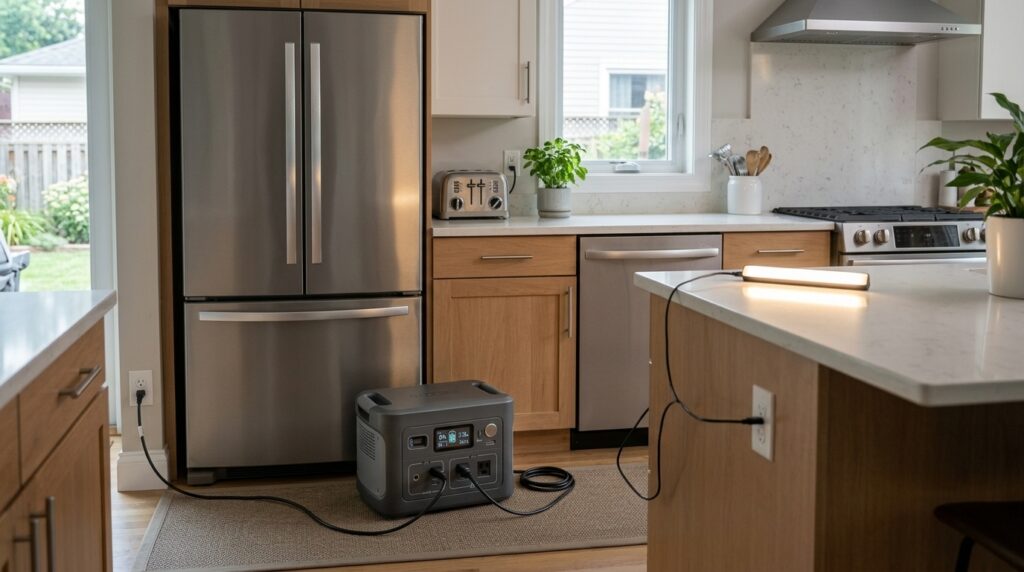
For a better estimate, determine the refrigerator’s energy use over 24 hours, ideally from its energy label or a plug-in electricity meter where appropriate.
For example, if a refrigerator uses 1.2kWh per day, a power station with approximately 2.6kWh of usable energy could theoretically provide a little over two days of energy for that refrigerator alone. In practice, the runtime may be shorter due to startup requirements, inverter losses, standby consumption, and changes in refrigerator demand.
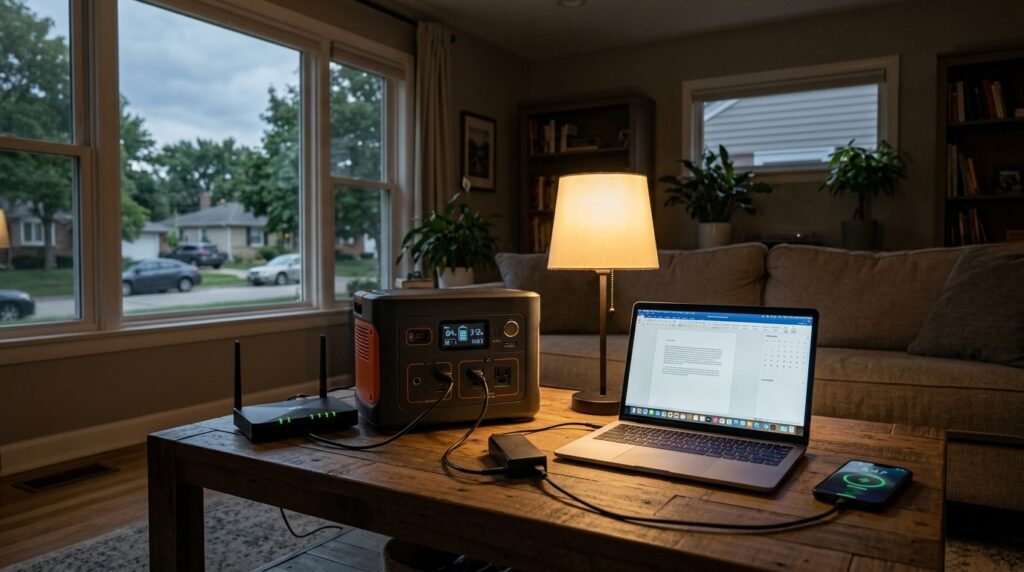
Example: Running a Wi-Fi Router, Laptop, and LED Lights
Suppose your essential devices consume:
- Wi-Fi router: 12W.
- Laptop: 60W while charging and in use.
- Four LED lights: 40W combined.
The total load is approximately 112W. A station with 1,000Wh of nominal capacity and around 850Wh of usable energy could theoretically power that load for about 7.6 hours.
Actual runtime depends on device behavior and the station’s own energy consumption. Reducing screen brightness, turning off unused lights, and disconnecting unnecessary equipment can extend backup time.
Portable Power Station vs. Home Battery Backup System
A portable power station and a fixed home battery system both store electricity, but they serve different needs.
| Feature | Portable Power Station | Fixed Home Battery System |
|---|---|---|
| Installation | Usually minimal for standalone use | Generally requires professional installation |
| Portability | Often movable, depending on size | Normally stationary |
| Capacity | Ranges from small to expandable systems | Can be designed for larger household loads |
| Household circuit integration | Depends on model and approved accessories | Often designed for integrated backup |
| Expansion | Available on selected models | Depends on the system |
| Initial cost | Can be lower for essential loads | Often higher due to equipment and installation |
| Best use | Portable essentials and selected appliances | Planned backup for designated household circuits or larger loads |
A portable unit may be enough for basic backup, while a fixed system can be more suitable for users who want automatic backup for selected circuits. The right choice depends on budget, local electrical requirements, expected outage duration, and total energy demand.
How Much Does a Portable Power Station for Home Backup Cost?
Prices vary by capacity, output, battery chemistry, solar input, expansion options, warranty, and regional availability. Promotional prices and package contents can also change frequently.
Rather than relying on one price that may quickly become outdated, consider the main factors that influence cost.
| Factor | How It Affects Cost |
|---|---|
| Battery capacity | Larger batteries generally cost more |
| Inverter output | Higher output can increase system cost |
| Battery chemistry | Chemistry and cell design influence price and life-cycle value |
| Solar input | Higher solar charging capacity may require more advanced hardware |
| Expansion support | Compatible extra batteries and accessories add to the total cost |
| UPS and home integration | Specialized functions may increase system and installation costs |
| Warranty and service | Local support and warranty coverage can affect long-term value |
How to Compare Value Instead of Price Alone
A cheaper station is not automatically the better purchase. Compare the usable energy, rated output, warranty, expected cycle life, charging options, and cost of any necessary accessories.
If you plan to recharge from solar panels, include the price of compatible panels, cables, mounting equipment, and any additional components. If you want to power fixed household wiring, include a professional assessment and any required approved transfer equipment.
Common Mistakes to Avoid When Buying a Portable Power Station
Choosing Capacity Without Calculating Energy Use
Buying a station based only on its advertised watt-hour rating can lead to disappointment. List the appliances you need, estimate their energy use, and decide how long each one must operate.
Ignoring Startup Power
Some refrigerators, pumps, and other motor-driven devices require more power when starting than while running. Check both the appliance’s starting demand and the power station’s supported surge capability.
Assuming Every Appliance Can Be Powered
High-demand appliances such as electric ovens, water heaters, space heaters, and air conditioners may drain a battery rapidly or exceed its output limit. Always compare the device’s requirements with the station’s specifications.
Overlooking Regional Compatibility
A power station intended for one market may have different outlets, voltage, frequency, and charging accessories from a model sold elsewhere. Confirm compatibility with the electrical system in your country.
Forgetting Solar Panel Compatibility
Not every solar panel works with every power station. The panel arrangement must stay within the station’s supported voltage, current, and power limits.
Assuming a Portable Unit Can Power an Entire Home
Connecting a power station to fixed household wiring requires a suitable, approved setup. Never backfeed a household circuit through an ordinary wall outlet. Use a qualified electrician and appropriate transfer equipment where required.
Safety Tips for Using a Portable Power Station at Home
Portable power stations are convenient, but safe use is essential.
- Read the manufacturer’s instructions before charging or connecting appliances.
- Keep the unit dry unless its rating explicitly permits exposure to the relevant conditions.
- Do not cover cooling vents or place the station near heat sources.
- Use compatible charging cables and accessories.
- Follow the specified charging and operating temperature limits.
- Keep the unit away from water and protect it from physical damage.
- Avoid exceeding the rated output or connecting incompatible appliances.
- Inspect cables and connectors for wear before use.
- Store the battery according to the manufacturer’s recommendations.
- Follow local electrical regulations for any connection to household circuits.
Unlike fuel-powered generators, battery power stations do not produce engine exhaust during operation. Nevertheless, their batteries and electrical components can present fire, shock, and overheating risks if damaged, misused, or charged incorrectly. Do not use a damaged battery pack.
Frequently Asked Questions
1. What Is the Best Portable Power Station for Home Backup in 2026?
The best option depends on your requirements. The EcoFlow DELTA 3 Plus is worth considering for everyday essentials, while the Anker SOLIX F3000 and BLUETTI Elite 300 offer larger battery capacity. The EcoFlow DELTA Pro 3 and Anker SOLIX F3800 are options for users who need a more capable or expandable setup.
Compare the exact model specifications, price, warranty, and regional availability before choosing.
2. How Many Watt-Hours Do I Need for Home Backup?
The answer depends on which devices you want to power and for how long. A few hours of router, laptop, and lighting backup may require considerably less energy than running a refrigerator and several other appliances overnight.
Estimate the watt-hours required by multiplying each device’s average power use by its operating time, then add the results and allow for conversion losses.
3. Can a Portable Power Station Run a Refrigerator?
Yes, many power stations can run compatible refrigerators if they provide enough continuous output, sufficient surge capacity, and adequate battery energy. Check the refrigerator’s startup demand and daily energy use before purchasing.
4. Can a Portable Power Station Run an Air Conditioner?
Some larger systems can run certain air conditioners, but compatibility depends on the air conditioner’s starting power, running power, voltage, and energy consumption. Battery runtime may be short because air conditioners can consume substantial energy.
5. Are Portable Power Stations Better Than Gas Generators?
Portable power stations are generally quieter and do not produce engine exhaust during operation. They are convenient for electronics and essential appliances, but their stored energy is limited unless recharged.
Fuel-powered generators can provide electricity for longer periods when fuel is available, but they require outdoor operation, proper distance from buildings and openings, and strict carbon monoxide precautions.
6. Can I Recharge a Portable Power Station With Solar Panels?
Many models support solar charging. The panels must be compatible with the station’s voltage, current, connector, and maximum input specifications.
Actual charging speed depends on sunlight, weather, panel angle, shading, and power consumption during charging.
7. How Long Does a Portable Power Station Battery Last?
Battery life depends on battery chemistry, charge cycles, temperature, storage conditions, and usage patterns. Some LFP models advertise thousands of cycles before reaching a specified remaining-capacity threshold, but this does not mean every battery will have the same service life.
Review the model’s cycle-life definition and warranty conditions.
8. Can I Leave a Portable Power Station Plugged In All the Time?
Some models support ongoing connection to AC power, but the correct procedure varies by product. Follow the manufacturer’s guidance for long-term connection, charging limits, battery storage, and ventilation.
9. What Is the Difference Between Watts and Watt-Hours?
Watts measure power, or the rate at which electricity is being used. Watt-hours measure energy, or the amount stored or consumed over time.
A station with high wattage can power demanding devices, but its battery capacity determines how long it can continue doing so.
10. Is a Portable Power Station Safe for Indoor Use?
A battery power station does not produce combustion exhaust during normal operation, unlike a fuel-powered generator. However, it must still be used according to its safety instructions, with suitable ventilation and clearance where required.
Never operate a petrol or diesel generator indoors, in a garage, or in another enclosed or partially enclosed space because of carbon monoxide risk.
11. Can a Portable Power Station Power My Whole House?
Some large, expandable systems can support selected household circuits or broader backup configurations with the right equipment. A standalone portable station should not be assumed to power an entire house automatically.
Whole-home backup requires careful consideration of peak load, total energy demand, voltage, circuit integration, and approved installation methods.
12. Is a Solar Power Station Worth Buying for Frequent Outages?
It can be worthwhile if you regularly experience power cuts and can recharge the battery between or during outages. Solar panels may reduce reliance on grid charging, but results depend on available sunlight, panel capacity, weather, and daily energy use.
Calculate the total system cost and compare it with the value of the backup power you need.
Conclusion
The best portable power stations for home backup in 2026 depend on your household’s energy needs, budget, and expected outage duration. Compact models such as the EcoFlow DELTA 3 Plus can be suitable for routers, laptops, lighting, and selected small appliances. Larger options such as the Anker SOLIX F3000 and BLUETTI Elite 300 provide more stored energy, while expandable systems such as the EcoFlow DELTA Pro 3 and Anker SOLIX F3800 may suit more demanding backup requirements.
Before making a decision, calculate your essential devices’ energy use, check rated and surge output, confirm local electrical compatibility, and compare the full cost of the station and accessories. Consider solar charging if outages are prolonged, and use a qualified electrician for any connection to household wiring.
A well-chosen power station can make outages easier to manage, but the most effective solution is the one that safely provides the right amount of power for the devices you genuinely need.