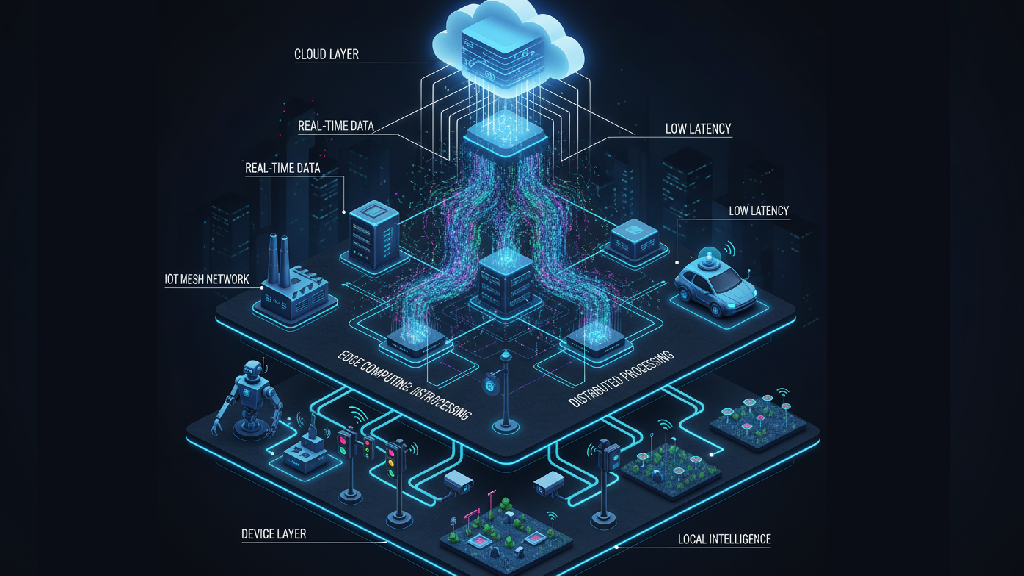
For over a decade, “The Cloud” has been the centerpiece of digital transformation. Centralized data centers owned by giants like Amazon, Microsoft, and Google processed almost everything. But as we move toward a world of 50 billion connected devices, the cloud is hitting a physical limit: Latency.
The Physics of Speed
Data cannot travel faster than the speed of light. When a self-driving car needs to make a split-second decision about a pedestrian, sending that data to a server 500 miles away and waiting for a response is too slow. Edge Computing solves this by moving the “brain” closer to the “eyes.”
By placing micro-servers at the base of cell towers, inside factory routers, or even within the devices themselves, processing happens locally. This results in:
- Ultra-Low Latency: Critical for VR/AR, remote surgery, and autonomous transit.
- Bandwidth Efficiency: Not every byte of data needs to be sent to the cloud; only the important summaries are uploaded.
- Enhanced Privacy: Sensitive data can be processed on-site without ever traversing the open internet.
The Infrastructure Challenge
The shift to the Edge requires a massive overhaul of global infrastructure. It involves the deployment of millions of “micro-data centers” and the perfection of 6G technology, which is designed to handle the massive density of these local connections. We are moving from a world with a few “Mega-Clouds” to a world with a “Computing Mist” that surrounds us everywhere.